

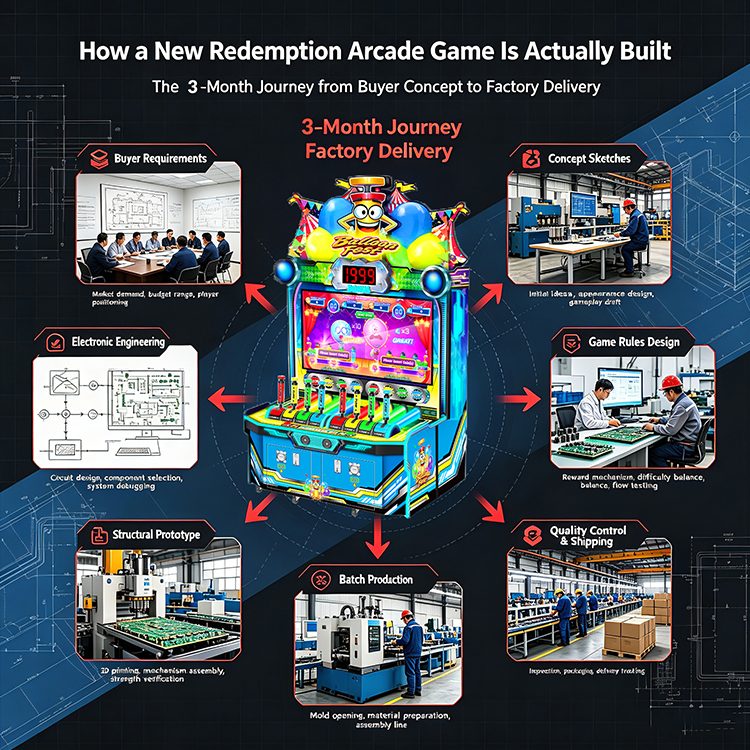
Every commercial arcade machine on a game floor started as a concept. Someone — a distributor spotting a market gap, an FEC operator wanting an exclusive product, or the manufacturer’s own R&D team spotting a trend — decided a new game needed to exist. Then a factory turned that concept into 200+ engineered components, tested it against real players, certified it for export, and shipped it to a container.
That process, from first concept to first commercial delivery, typically takes 3 months. It requires collaboration between industrial designers, mechanical engineers, electronics engineers, software engineers, quality assurance teams, and export documentation specialists. And it is invisible to almost every buyer who eventually places an order.
This article walks through that development process at Sunflower Amusement — the actual sequence, the actual timelines, the actual decisions — from the perspective of the design and systems engineering teams who do the work. It is written for OEM/ODM buyers, distributors evaluating manufacturer capability, and large-volume investors who want to understand who is actually behind the machines they’re buying.
WEEK First — The Buyer Brief (or the Internal R&D Trigger)
Buyer perspective: A distributor in the UAE contacts Sunflower’s OEM/ODM department. Her observation: the local FEC market is saturated with generic 4-player coin pushers, and operators are asking for something new — a coin pusher with a themed IP overlay and a secondary skill mechanic. She wants an exclusive design she can market under her own brand across the GCC region.
Or the trigger might come from within: Sunflower’s R&D team perspective: Our sales team returning from IAAPA notices that three separate FEC chain buyers asked for a specific format — a 3-player cooperative redemption game where players work together to defeat a shared challenge. No existing product covers this. We open an internal R&D file.
Either way, the first step is identical: a formal design brief document is opened. It specifies:
- Target market and end-user demographic
- Target price point (which drives BOM decisions)
- Physical form factor constraints (cabinet dimensions, floor footprint)
- Player capacity and interaction model
- Required certifications for target export markets
- Estimated first-year production volume
For OEM/ODM projects, this brief is co-authored with the customer. For internal R&D projects, it’s authored by our product management team based on market signals.
Deliverable at end of Week 0: A signed design brief and, for OEM projects, an initial commercial framework agreement.
WEEK 1–2 — Industrial Design and Gameplay Concept
Design engineer perspective: This is the phase where the game gets its identity. Our industrial design team works in three parallel streams:
Stream 1 — Cabinet and Form Factor Design
We build 3D CAD models of the proposed cabinet using SolidWorks. Key design decisions in this phase:
Player ergonomics:
- Where does the player stand or sit? What’s the eye-line to the playfield? Can a 6-year-old and a 6-foot adult both play comfortably?
Serviceability:
- Where do service doors open? Can the coin box be emptied without shutting down the machine? Can the main PCB be swapped in under 15 minutes?
Manufacturing feasibility:
- Can this cabinet be assembled from flat-pack panels? Can it fit through a standard 32-inch venue door post-assembly?
Container loading efficiency:
- Does the cabinet’s shipping dimensions optimize container loading? (See our previous article on container load planning.)
Stream 2 — Gameplay Mechanic Design
The game designer works with the mechanical engineer to answer: how does the game actually work? Player interaction, scoring, ticket payout algorithm, difficulty progression, sensory feedback loops.
For a new game, we typically prototype 3–5 different gameplay variations before selecting one for engineering development. This is done with rough physical mockups and simple electronic breadboards — no beauty, all function.
Stream 3 — Visual Theme and Artwork Direction
Our graphic design team produces mood boards, character concepts, and cabinet artwork proposals. For OEM customers, this stream aligns with the customer’s brand guidelines. For internal projects, we develop the theme from scratch or in collaboration with an IP licensing partner.
Deliverable at end of Week 2: Approved 3D cabinet renderings, gameplay design document, and artwork direction. Buyer sign-off required before proceeding.
WEEK 3–5 — Engineering Design and BOM Specification
Systems engineer perspective: This is where the design becomes a real, buildable machine. Our engineering team splits into three tracks:
Mechanical Engineering
The mechanical engineer takes the industrial design’s cabinet model and specifies every physical component:
- Steel bracket dimensions and material grades
- Motor specifications with MTBF requirements
- Gear ratios, drive belts, and mechanical linkages
- Sensor placement and mounting brackets
- Cable routing paths (invisible but critical for reliability)
We produce full mechanical drawings for every part that will be manufactured or sourced. For every purchased component (motors, sensors, dispensers), we specify approved brands and part numbers — the BOM I described in Article 8.
Electronics Engineering
Our electronics team designs the game PCB in Altium Designer or KiCad. Key decisions in this phase:
- MCU selection (typically STM32 family for our commercial designs)
- Board layer count (4-layer minimum, 6-layer for signal-integrity-critical designs)
- Component specifications with brand approval (Japanese capacitors, commercial-grade motor drivers, etc.)
- Firmware architecture — game logic, sensor polling, payout algorithm, cashless interface
The PCB is typically iterated through 2–3 revisions before production release. Each revision is prototyped in a small batch (5–20 boards) for internal testing.
Software Engineering
Game software is developed in parallel with hardware. Our software team writes:
- The main game state machine in C or C++
- Sensor input handlers and motor control loops
- The ticket payout algorithm (adjustable by the operator; typically defaults to 20–25% COGS ratio)
- The audio and visual feedback subsystem
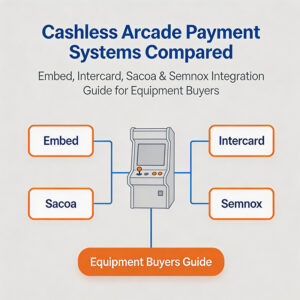
- The cashless system integration (Embed, Intercard, Sacoa, Semnox protocols)
- The operator menu system for calibration and reporting
For OEM projects with custom software features, this phase can extend by 4–8 weeks.
Deliverable at end of Week 5: Complete engineering specification package — mechanical drawings, PCB gerbers, software architecture document, and full BOM. Formal engineering review with the project manager and, for OEM projects, the customer.
WEEK 6–8 — Prototype Build and Alpha Testing
Design engineer perspective: Now we build the first real machine. Our prototype shop constructs 2 to 4 alpha units by hand, using the mechanical drawings and PCB assemblies from the engineering phase.
The first prototype almost never works perfectly. That’s expected — that’s the whole point of prototyping.
Common issues found in alpha testing:
Sensor placement errors
- — a photoelectric sensor might trigger from unintended reflections; we move it or add a shroud
Motor torque under-specification
- — the motor works fine at room temperature but stalls after 30 minutes of continuous operation; we upgrade to the next torque class
Software timing bugs
- — the ticket dispenser fires before the game’s win animation completes; we adjust the state machine
Cabinet stress points
- — a corner joint flexes when the machine is jostled; we add a steel reinforcement bracket
Systems engineer perspective: We run each alpha unit through a 168-hour continuous operation test (7 days x 24 hours). We log every fault, every unexpected sensor reading, every temperature excursion. Any component that fails or shows anomalous behavior gets flagged for redesign or supplier change.
For OEM projects, alpha units are shipped to the customer for their own testing. Customer feedback is folded into the beta iteration.
Deliverable at end of WEEK 8: Working alpha units with all critical issues resolved. Engineering release for beta production.
WEEK 9–11 — Beta Production and Field Testing
Design engineer perspective: We produce a beta batch of 5–15 machines using production-intent tooling and processes. This tests not just the design, but the manufacturability of the design — can we consistently build this machine at production volume without hand-fitting?
Some beta units go to internal long-duration testing (500+ hours continuous operation). Others go to trusted FEC partners for real-world field testing under commercial load. Field test partners commit to reporting every fault, service call, and player-behavior observation.
Common insights from field testing:
- Players interact with the machine differently than designers expected (they hit buttons harder, or push panels in ways that stress unseen components)
- Cabinet artwork that looked great in the CAD render looks washed-out under real FEC lighting
- Sound levels that felt right in the quiet R&D lab are inaudible in a real arcade environment
- Operator menu screens that seem intuitive to us are confusing to actual venue staff
Every insight loops back into design refinement.
Deliverable at end of Month 11: Field-tested design with all known issues resolved. Ready for pre-production ramp.
WEEK 12–14 — Certification and Compliance
Systems engineer perspective: Before we can ship the machine commercially, we need certification. The specific certifications depend on target markets:
CE Certification (EU Market)
We prepare the Technical Construction File (TCF), which documents the machine’s compliance with:
- Low Voltage Directive (2014/35/EU) — electrical safety
- EMC Directive (2014/30/EU) — electromagnetic compatibility
- Machinery Directive (2006/42/EC) — mechanical safety
Third-party lab testing typically takes 3–6 weeks and costs USD 2,500–8,000 depending on complexity. The lab issues test reports; we issue the Declaration of Conformity.
RoHS Compliance (EU + Global)
Restriction of Hazardous Substances — verification that no restricted materials (lead, mercury, cadmium, hexavalent chromium, PBB, PBDE) are present in the machine above allowable levels. This drives sourcing decisions for solder, plating, and plastics.
SASO / SABER (Saudi Arabia)
For KSA-bound units, we register the product on the SABER platform and obtain the Product Certificate of Conformity (PCoC). Timeline: 3–6 weeks. Cost per model: USD 800–2,500.
FCC (US Market)
For products with any wireless communication (cashless RFID modules, Wi-Fi diagnostics), FCC Part 15 certification is required. Testing and filing typically USD 3,000–7,000.
Other Regional Certifications
Depending on target markets: ECAS (UAE), NOM (Mexico), INMETRO (Brazil), NEMKO (Nordic), and others.
Deliverable at end of Week 14: Complete certification package for all target markets. Machine is legally exportable.
WEEK 15–16 — Pre-Production Tooling and Supply Chain Setup
Design engineer perspective: Between beta and mass production, we finalize:
Injection molds
- for custom plastic components (cost: USD 15,000–80,000 per mold, amortized across expected production volume)
Cabinet cutting programs
- for CNC routing of MDF panels
Assembly jigs and fixtures
- to ensure consistent assembly at production volume
PCB production files
- released to our board manufacturing partner (typically 2 weeks lead time for first production run)
Systems engineer perspective: We finalize component supply agreements with our vetted suppliers. For long-lead-time components (specialty PCBs, custom motors, licensed IP artwork), we place initial production orders 6–8 weeks before mass production start.
For OEM customers, this is when they typically place the formal purchase order for the first production run.
WEEK 17–18 — Mass Production and First Container
Design engineer perspective: Mass production ramps in phases:
- day 1: First 5 units off the production line. Full inspection, functional testing, and QA sign-off before continuing.
- day 2: Ramp to 20–40 units. Continuous QA sampling and burn-in testing.
- day 3–4: Full production rate. Container-ready inventory begins accumulating.
Systems engineer perspective: Every machine off the production line goes through:
48-hour burn-in test
- — powered continuously with automated cycle testing
Full functional test
- — every button, sensor, motor, and payout mechanism verified
Cosmetic inspection
- — cabinet, artwork, and packaging quality
Documentation package
- — operating manual, wiring diagram, spare parts list, warranty card
Approved machines are palletized (per our standard export practice, and mandatory for KSA-bound shipments) and prepared for container loading.
Deliverable at end of Month 18: First container shipped. The 18-month development cycle is complete — from concept to commercial delivery.
What This Means for OEM/ODM Buyers
For distributors and large-volume buyers evaluating OEM/ODM manufacturing partners, the 18-weeks cycle is the reality check on capability claims. Ask these questions of any manufacturer proposing to build a custom machine:
“Show me your last 3 completed OEM projects and their timelines.”
1. Manufacturers with real R&D capability can show projects. Manufacturers who claim OEM but have never actually completed one cannot.
“Who is your in-house PCB designer and what design tool do they use?”
2. Real answers: “Our senior EE has 12 years experience, works in Altium Designer.” Vague answers: red flag.
“What is your certification lab partner network?”
3. Established manufacturers have ongoing relationships with certified labs and can quote realistic timelines. Manufacturers without certification experience will typically underestimate this phase by 50%.
“Can I visit during a beta production run?”
4. Serious manufacturers welcome customer visits. Cost-cut manufacturers make excuses.
At Sunflower Amusement, we have completed over 40 OEM/ODM projects for distributors and FEC chains across the MENA, LATAM, EU, and North American markets. Our development team operates from a dedicated R&D facility in Guangzhou with in-house mechanical, electrical, and software engineering capabilities. For qualified customers, we welcome factory visits and provide project timelines with contractual milestone commitments.
Considering a custom OEM or ODM project? Contact Sunflower Amusement’s Product Development Department to schedule an initial project scoping call, or review our current catalog to see the range of machines our engineering team has developed.
FAQ
Q: How long does it take to develop a new commercial arcade machine? A: A full ground-up development cycle from concept to first commercial delivery typically runs 3 months. For OEM projects that modify an existing platform (custom branding, new artwork, minor gameplay changes), the timeline compresses to 3–6 weeks.
Q: What is the difference between OEM and ODM in arcade manufacturing? A: OEM (Original Equipment Manufacturer) typically means the buyer takes an existing manufacturer product and rebrands or lightly customizes it. ODM (Original Design Manufacturer) means the buyer commissions a completely new product design that they will own or exclusively distribute. ODM projects have longer timelines but produce genuinely exclusive product.
Q: How much does OEM/ODM development cost? A: OEM (light customization) projects typically require MOQ commitments of 20–100 units per SKU with limited or no development fee. Full ODM projects typically require MOQ commitments of 50–500 units plus development fees ranging from USD 15,000 to USD 120,000 depending on complexity.
Q: Can I own the intellectual property (IP) of an ODM design? A: Yes, this is negotiated in the ODM agreement. Full IP transfer, exclusive territory rights, or non-exclusive licensing arrangements are all common structures. At Sunflower, we respect IP exclusivity for committed ODM customers and formalize this in written agreements.
Q: How do I verify a manufacturer has real R&D capability vs just assembly capability? A: Ask to see their engineering team org chart, their design software licenses (Altium, SolidWorks, KiCad), their certification project history, and their prototype shop. Real R&D operations have specialized equipment (3D printers, CNC prototyping, PCB assembly stations, environmental test chambers). Assembly-only factories don’t.
Q: What happens if the initial design doesn’t work out during prototyping? A: This is expected. Every prototype iteration is an opportunity to catch problems before they become field failures. Serious manufacturers plan for 2–3 prototype revisions and budget the time accordingly. Manufacturers who claim “first prototype is production-ready” are either extremely lucky or cutting corners.
Q: Can I visit the factory during the development process? A: At Sunflower Amusement, yes — for qualified buyers with active projects. Factory visits are especially valuable during the beta production phase, when you can see your product being built and provide real-time feedback.
Internal Link Suggestions:

Add comment