


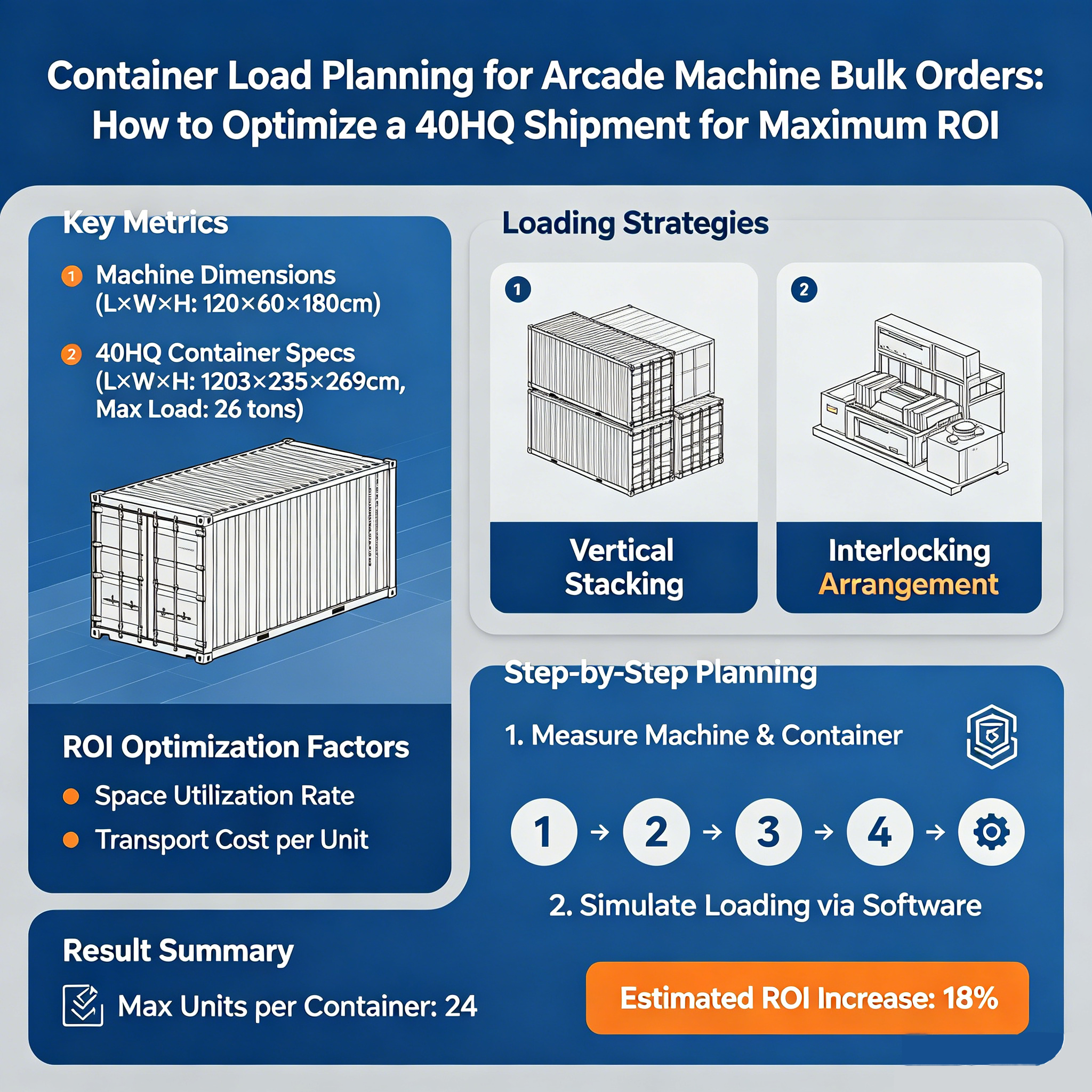
Arcade machines are top-heavy by design because CRT/LCD monitors, lighting fixtures, and ticket dispensers are all installed within the upper cabinet sections. Therefore, strict container weight distribution regulations must be followed throughout the loading process, especially for arcade machine wholesale shipments, and the core guidelines for bulk consignments are listed below:
First of all, place the heaviest units against the bottom and end walls of the container; under no circumstances should you stack heavy units on top of lighter ones — this basic rule directly cuts damage risks for arcade machine wholesale orders.
Second, pay close attention to the maximum stacking height requirement. Since most arcade machines lack structural reinforcement for multi-layer stacking during ocean transport, single-row loading is universally adopted as the standard practice.
Third, sufficient bracing and strapping measures are mandatory. To secure cargo steadily, fasten industrial-grade ratchet straps every 2 meters along the cabin walls. Meanwhile, insert inflatable dunnage bags between separate rows so as to eliminate cargo shifting caused by rough ocean waves.
Fourth, equal focus should be given to weight balance control. Specifically, the total weight of all cargo needs to be distributed roughly evenly from front to back; otherwise, the container may tilt dangerously while cranes lift and transfer it at port terminals.
In summary, a professionally loaded container can reach its destination with no shifted units, cracked acrylic panels, or loose detached parts at all. In contrast, all three types of damage mentioned above frequently occur whenever loading work is done hastily by inexperienced amateur crews.
This guide is built for buyers who order arcade machine wholesale by the container
Many industry buyers struggle to quantify logistics expenses accurately, so this guide is tailored for stakeholders who want to fully grasp how machine dimensions, palletization standards, mixed-SKU loading strategies, and container loading sequences jointly impact overall delivered costs.
Specifically, for arcade machine wholesale distributors and procurement teams from FEC chains that place large bulk orders, per-unit freight expense ranks among the most adjustable cost factors that determine overall transaction profitability.
In fact, a stark cost gap exists between poorly arranged 40HQ containers holding merely 10 machines and professionally optimized containers capable of fitting 14 to 16 units; as a result, buyers can cut USD 200–600 off the shipping cost of each machine, and such savings will immediately boost their gross profit margins.
The Container Math: Why Most Buyers Pay Too Much
A standard 40-foot High Cube (40HQ) container offers approximately:
- Internal length: 12.03 m (39.5 ft)
- Internal width: 2.35 m (7.7 ft)
- Internal height: 2.69 m (8.8 ft)
- Internal volume: ~76 cubic meters (CBM)
- Maximum payload weight: ~26,500 kg
A 20-foot General Purpose (20GP) container offers about half the volume but at roughly 60–70% of the freight cost. The economics almost always favor 40HQ for any order of 6+ machines — but only if the container is loaded efficiently.
The buyers reality check:
A typical mixed redemption order loaded by an inexperienced factory packing team often achieves only 60–70% volume utilization. The same order loaded by an export-experienced factory typically reaches 85–92% utilization. That gap is real money.
—
Standard Arcade Machine Dimensions Reference
Container load planning starts with knowing your cargo. Indicative shipping dimensions for the major arcade categories (your factory should provide exact specs per SKU):
Single-Player Redemption Machines
- Typical shipping dimensions: 95 cm (W) × 100 cm (D) × 200 cm (H)
- Shipping weight: 130 – 220 kg
- Container fit: 22 – 28 units per 40HQ when palletized correctly
Single-Player Coin Pushers
- Typical shipping dimensions: 90 cm (W) × 95 cm (D) × 220 cm (H)
- Shipping weight: 180 – 280 kg
- Container fit: 18 – 24 units per 40HQ
Multi-Player Coin Pushers (4-station)
- Typical shipping dimensions: 160 cm (W) × 130 cm (D) × 240 cm (H)
- Shipping weight: 380 – 520 kg
- Container fit: 8 – 12 units per 40HQ
Large Anchor / Multiplayer Cabinets
- Typical shipping dimensions: 200 cm (W) × 150 cm (D) × 250 cm (H)
- Shipping weight: 450 – 750 kg
- Container fit: 5 – 8 units per 40HQ
Crane / Prize Vending Machines
- Typical shipping dimensions: 100 cm (W) × 105 cm (D) × 195 cm (H)
- Shipping weight: 140 – 200 kg
- Container fit: 26 – 32 units per 40HQ
Children’s Redemption Games (small format)
- Typical shipping dimensions: 80 cm (W) × 85 cm (D) × 170 cm (H)
- Shipping weight: 100 – 160 kg
- Container fit: 32 – 38 units per 40HQ
—
The Loading Decision: 20GP vs 40HQ vs LCL
| Order Size | Best Container Choice | Reason |
| 1–4 machines | LCL (Less than Container Load) | Container is overkill; LCL freight is cheaper despite higher per-CBM rate |
| 5–10 machines | 20GP | Filled efficiently; affordable freight |
| 11–20 machines | 40HQ | Best per-unit freight economics; standard distributor order |
| 21–30 machines | 40HQ + 20GP combo, or 2x 40HQ | Volume optimization |
| 30+ machines | Multiple 40HQ | Bulk freight rates; potential factory volume discount |
LCL warning: Less-than-container-load shipping seems attractive for small orders but carries hidden costs: longer transit times (often 1.5–2x), higher per-CBM rates, more handling damage risk, and additional consolidation/deconsolidation fees of USD 200–500 per shipment.
—
Mixed SKU Strategy: The Distributor’s Optimization Lever
Buyers who order a single SKU in a container almost always under-utilize space because of dimensional inefficiency. Mixed SKU loading — combining different machine categories in one container — typically delivers 15–25% more units per container.
The Pyramid Loading Principle
The most space-efficient 40HQ loading combines:
- Heavy/wide units on the bottom (multi-player coin pushers, anchor cabinets)
- Medium units in the middle layer (single-player coin pushers, standard redemption games)
- Light/small units stacked on top or in gaps (crane machines, children’s games, prize vending)
- Spare parts and accessories in the door-side gap (always reserve 30–40 CBM of door-end space for the parts kit)
Real Example: Optimized Mixed Container for a Distributor First-Time Order
40HQ container, FOB Guangzhou destination Jeddah:
| SKU Type | Quantity | Total CBM | Total Weight (kg) | FOB Value (USD) |
| Single-player redemption | 8 | 15.2 | 1,440 | 22,400 |
| Single-player coin pusher | 4 | 7.5 | 920 | 14,000 |
| Multi-player coin pusher (4-station) | 2 | 9.9 | 880 | 18,000 |
| Crane / prize vending | 3 | 6.1 | 540 | 9,000 |
| Spare parts & accessories kit | 1 lot | 2.0 | 180 | 2,500 |
| Total | 17 machines | 40.7 CBM (~85% util.) | 3,960 kg | 65,900 |
Freight cost per unit at USD 2,200 for 40HQ: ~USD 129 per machine. Compare to the same 17 machines shipped LCL: USD 480–650 per machine. The 40HQ saves USD 6,000+ in freight alone.
—
Palletization Rules That Affect Loading Capacity
The post-2025 Saudi palletization mandate has made palletized loading the new operational standard for MENA shipments, and is increasingly preferred in LATAM ports as well. The trade-off:
- Palletized loading: Easier port handling, faster customs clearance, mandatory for KSA, reduces in-transit damage by 60–70%. But consumes 8–12% additional container volume per pallet.
- Floor-loaded (loose): Maximum volume utilization but no longer accepted in KSA, slower port handling, higher in-transit damage rate.
Practical guidance: For MENA-bound containers, plan for 80–88% utilization with palletization built in. For LATAM and EU, palletization is preferred but optional — plan for 85–92% utilization.
—
Weight Distribution and Stability
Arcade machines are top-heavy by design because CRT/LCD monitors, lighting fixtures, and ticket dispensers are all installed within the upper cabinet sections. Therefore, strict container weight distribution regulations must be followed throughout the loading process, especially for arcade machine wholesale shipments, and the core guidelines for bulk consignments are listed below:
First of all, place the heaviest units against the bottom and end walls of the container; under no circumstances should you stack heavy units on top of lighter ones — this basic rule directly cuts damage risks for arcade machine wholesale orders.
Second, pay close attention to the maximum stacking height requirement. Since most arcade machines lack structural reinforcement for multi-layer stacking during ocean transport, single-row loading is universally adopted as the standard practice.
Third, sufficient bracing and strapping measures are mandatory. To secure cargo steadily, fasten industrial-grade ratchet straps every 2 meters along the cabin walls. Meanwhile, insert inflatable dunnage bags between separate rows so as to eliminate cargo shifting caused by rough ocean waves.
Fourth, equal focus should be given to weight balance control. Specifically, the total weight of all cargo needs to be distributed roughly evenly from front to back; otherwise, the container may tilt dangerously while cranes lift and transfer it at port terminals.
In summary, a professionally loaded container can reach its destination with no shifted units, cracked acrylic panels, or loose detached parts at all. In contrast, all three types of damage mentioned above frequently occur whenever loading work is done hastily by inexperienced amateur crews.
—
Document Trail for Bulk Container Orders
Every bulk container order should be documented with:
1. Detailed packing list — itemized by SKU, quantity, CBM, and weight per pallet
2. Loading photographs — 8–12 photos showing pallet arrangement before container door closure; provided by the factory before shipping
3. Container seal number — recorded on the bill of lading; container must arrive at destination with seal intact
4. Pre-shipment inspection (PSI) report — optional but recommended for first-time deals; conducted by a third-party agency (SGS, Intertek, Bureau Veritas) at the factory before container release
—
Volume Pricing and the Distributor Discount Ladder
Manufacturers typically structure pricing in tiered volume bands. Indicative discount structure from factory wholesale baseline:
| Annual Container Volume | Typical Discount vs. Base Wholesale |
| 1 container/year (first-time buyer) | 0% (full wholesale) |
| 2–3 containers/year | 3% – 6% |
| 4–6 containers/year | 7% – 12% |
| 7–10 containers/year | 12% – 18% |
| 10+ containers/year | 18% – 25% + extended payment terms |
The economic logic: a distributor committed to 20+ containers per year is a long-term partner who reduces factory marketing cost and stabilizes production planning. Factories like Sunflower Amusement reward that commitment with structured discounts and extended payment terms (30/60/90-day options at higher volume tiers).
—
Sunflower Amusement’s Container Loading Standards
Sunflower Amusement operates from a dedicated export facility in Guangzhou with an in-house loading team experienced in MENA and LATAM container preparation. Standard operating procedures for every export container:
- Pre-load CBM and weight optimization based on the customer’s SKU mix
- Mandatory palletization for KSA-bound containers with IPPC-stamped wood pallets
- Loading photographs provided to the customer before container seal
- Spare parts kit included in every container for the SKUs shipped (no additional cost)
- Container seal documentation and bill of lading prepared with telex release option
For arcade machine wholesale distributors planning their first 40HQ order, the factory’s export coordinator can model the optimal SKU mix against your budget and container volume targets.
| Planning a bulk container order? [Request a customized 40HQ load plan and quotation] (https://www.sunfloweramusements.com/contact-us-amusement-machine-manufacturer-wholesale/) or [browse the catalog by category]( https://www.sunfloweramusements.com/shop/) to start building your SKU mix. |
—
FAQ
1.Q: How many arcade machines fit in a 40HQ container?
1.A: Between 10 and 30 units depending on the SKU mix. A pure multi-player coin pusher order fits 8–12 units; a children’s redemption mix can reach 32+ units. The realistic average for a balanced distributor stocking order is 14–20 machines.
2.Q: Is it cheaper to order one 40HQ or two 20GP containers?
A: Almost always one 40HQ. A 40HQ container holds approximately 2.5x the volume of a 20GP but typically costs only 50–70% more in freight. For any order above 10 machines, 40HQ is the clear economic choice.
2.Q: Can I mix different machine SKUs in one container?
A: Yes — and you should. Mixed SKU loading typically delivers 15–25% more units per container than single-SKU loading due to better dimensional fit. Factories experienced with mixed container loading (Sunflower Amusement and other tier-1 arcade machine wholesale exporters) actively optimize this for the customer.
3.Q: What is the minimum order quantity (MOQ) for a container shipment?
3.A: There is no fixed MOQ for a container — the container is the unit. The practical MOQ is the number of machines needed to make a 20GP or 40HQ economically sensible (typically 5+ for 20GP, 11+ for 40HQ). Below those thresholds, LCL or air freight is more cost-effective despite higher per-unit rates.
4.Q: How long does container shipping take from China to Saudi Arabia or Mexico?
4.A: Jeddah/Dubai: 18–28 days port-to-port. Manzanillo (Mexico): 28–35 days. Santos (Brazil): 35–42 days. Add 7–14 days for clearance and inland trucking to your warehouse.
5.Q: Should I order a spare parts kit with every container?
5.A: Yes — always. The marginal cost is small (USD 1,500–3,500 per container), but the value to your end-customer relationships is enormous. A distributor with parts in stock can fix a customer’s broken machine in 48 hours; a distributor without parts loses the customer to a competitor on the second service call.
6.Q: What is the risk of damage in container shipping, and how is it covered?
A: Industry-average damage rate for properly loaded arcade containers is 1–3% of units showing minor cabinet damage (cosmetic only). Mechanical or electronic damage is rare with palletized loading. Marine insurance (0.3–0.6% of cargo value) covers material damage — always purchase it.
—


Add comment