


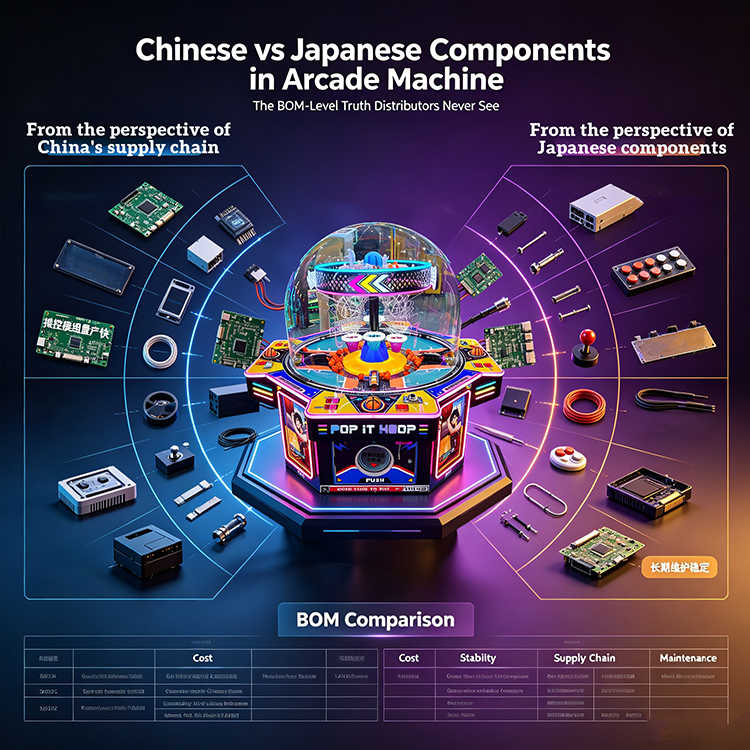
Every arcade machine distributor has had this conversation with a Chinese manufacturer: “Our machines use the same components as the Japanese brands.” Sometimes it’s true. More often, it’s marketing language that hides the specific component sourcing decisions that separate a machine that runs reliably for 6 years from one that dies in 18 months.
This article is written by Sunflower Amusement’s systems engineering team to give distributors, procurement managers, and FEC investors a real look inside the Bill of Materials (BOM) — the document that lists every single component in a machine and where it came from. Understanding the BOM is what separates informed buyers from buyers who get burned.
The Marketing Gap vs the Manufacturing Reality
Buyer perspective: A distributor visits IAAPA Expo. Three Chinese manufacturers show a similar multi-player coin pusher at prices ranging from USD 4,200 to USD 7,800. All three sales reps say the same thing: “commercial grade,” “Japanese components,” “5-year warranty support.” The buyer picks the middle option at USD 5,600 as a “safe compromise.”
Two years later, the machine’s coin acceptor fails during a busy weekend. The distributor tries to source a replacement CH-926 acceptor and discovers that the machine’s original part isn’t a CH-926 at all — it’s a visually similar generic unit with a modified pinout that only that specific factory uses. The distributor is locked in. Original parts cost 3x the market rate, ship in 6 weeks, and require a proprietary interface cable.
The “Japanese components” claim was true for one component: the LCD panel. Everything else was sourced from the Guangzhou electronics wholesale market at the lowest possible price.
Why the BOM Matters (and Why Buyers Rarely See It)
A commercial arcade machine BOM typically contains 180–260 line items. Each line specifies:
- Component category (e.g., “electrolytic capacitor, 470uF, 25V”)
- Manufacturer brand
- Manufacturer part number
- Quantity per machine
- Approved substitutes (if any)
Legitimate commercial manufacturers maintain detailed BOMs and are willing to share summary versions with serious buyers under NDA. Cost-cut manufacturers either don’t maintain formal BOMs (they buy whatever’s cheapest that week) or refuse to share them.
At Sunflower Amusement, we maintain a full component-level BOM for every machine we produce, revised quarterly. Below is a category-by-category walkthrough of the sourcing decisions that go into a real commercial redemption machine.
Category 1 — Electrolytic Capacitors
Systems engineer perspective: Electrolytic capacitors are the single most common failure point in any commercial electronic device operating at elevated temperatures. In an arcade machine, the internal cabinet temperature during operation typically runs 15–25°C above ambient. In a hot venue in Riyadh or Dubai in summer, that means the internal environment can reach 45–55°C.
At these temperatures, capacitor quality is everything.
| Component Grade | Brand Examples | Rated Life (@ 105°C) | Real-World Life | Cost per Unit |
| Premium Japanese | Rubycon YXG, Nichicon PW, Panasonic FR | 8,000–10,000 hours | 6–8 years | USD 0.28–0.55 |
| Standard Japanese | Nichicon HD, Panasonic ED | 5,000 hours | 4–5 years | USD 0.18–0.32 |
| Premium Taiwanese | Lelon, Teapo | 3,000–5,000 hours | 3–4 years | USD 0.10–0.22 |
| Chinese branded | CapXon, ChengX | 2,000–3,000 hours | 2–3 years | USD 0.06–0.15 |
| Spot-market generic | Unbranded / relabeled | Unspecified | 6–24 months | USD 0.03–0.08 |
A typical arcade arcade machine PCB uses 15–30 electrolytic capacitors. The cost difference between all-Japanese premium vs all-spot-market generic across an entire PCB: USD 8–18. Yes — the difference between a 6-year-reliable PCB and a 1-year time bomb is USD 8–18 per machine.
How to verify capacitor quality as a buyer: Ask for a photograph of the main game PCB. Japanese premium capacitors have distinctive markings — Rubycon capacitors have “RUBYCON” clearly printed; Nichicon shows “NICHICON” and a series code (HE, HD, PW, etc.); Panasonic shows the brand and series (FR, ED, etc.). Generic capacitors show illegible or crude markings.
Category 2 — Motors and Actuators
Design engineer perspective: Motors do the physical work in a redemption machine. They also draw the most current, generate the most heat, and take the most mechanical stress. Motor sourcing decisions have a direct effect on the machine’s operational reliability.
Main Gameplay Motors
Commercial-grade options and where they come from:
| Brand / Origin | Type | MTBF | Cost per Unit | Notes |
| Mabuchi (Japan) | Brushed / brushless DC | 30,000–60,000 hours | USD 22–48 | Long-established standard in arcade industry |
| Nidec (Japan) | Brushless DC | 50,000–100,000 hours | USD 35–75 | Premium tier, minimal maintenance |
| Buhler (Germany) | Brushed DC | 40,000–70,000 hours | USD 45–90 | European arcade standard |
| Johnson Electric (HK/China) | Brushed / brushless DC | 20,000–40,000 hours | USD 12–28 | Reliable mid-tier commercial |
| Generic Chinese spot-market | Brushed DC | 5,000–15,000 hours | USD 4–12 | High failure rate under commercial load |
Systems engineer note: The temptation for cost-cut manufacturers is to specify a “similar-looking” generic motor. The visible cabinet, gear housing, and mounting bracket look identical to a Mabuchi motor. The internal windings, bearings, and brush quality are completely different. The failure typically shows up 12–18 months post-purchase — well after the warranty period has expired.
Servo Motors (for precision positioning)
Some redemption games use servo motors for precise target positioning. Industry-standard brands include Futaba (Japan), Hitec (Korea), and Feetech (China commercial-grade). Generic servo motors from unspecified sources are the most common failure point in cost-cut skill games — the position drift after 3–6 months of commercial use makes the game unpredictably unfair to players.
Category 3 — Sensors
Systems engineer perspective: Sensors are the eyes of the machine. Every ball drop, every target hit, every coin insertion, every ticket dispensed — all monitored by sensors reporting to the main PCB.
Photoelectric (Infrared) Sensors
Commercial-standard brands:
OMRON (Japan)
- — the arcade machine industry benchmark. E3Z and E3T series. Cost: USD 8–18 per unit.
Panasonic (Japan)
- — CX and NX series. Equivalent quality to OMRON. Cost: USD 8–20.
SICK (Germany)
- — used in high-precision applications. Cost: USD 20–45.
Autonics (Korea)
- — solid commercial alternative. Cost: USD 5–12.
Chinese generic
- — unbranded or private-label. Cost: USD 0.80–2.50.
The failure pattern in cost-cut sensors: susceptibility to ambient light interference. In a bright arcade machine with heavy LED cabinet lighting, a cheap sensor generates 1–5% false positives — meaning the machine occasionally counts a “goal” or “ball drop” that never happened, and pays out phantom tickets. Multiply this across a busy weekend and the operator loses significant ticket-value revenue.
Micro-Switches
For coin door detection, service door open detection, and mechanical position feedback, commercial arcade machines use micro-switches from:
OMRON D2F / D3V
- (Japan) — 1,000,000 cycle rating
Cherry / ZF
- (Germany/US) — 100,000–500,000 cycle rating
Chinese generic
- — often unspecified, real-world failure at 50,000–150,000 cycles
Micro-switch failure is annoying (a false “door open” reading disables the machine) and hard to diagnose in the field.
Category 4 — PCB and Microcontroller
Systems engineer perspective: The main game PCB is where the machine’s logic lives. Buyers rarely inspect PCBs, but PCB quality is one of the strongest signals of overall manufacturing seriousness.
PCB Manufacturing
Two objective quality markers on any PCB:
Layer count
- — 4-layer minimum for commercial reliability; 6-layer standard for high-signal-integrity designs. 2-layer boards are a red flag.
Copper weight
- — 2 oz/ft² for power traces; 1 oz/ft² for signal traces. Cost-cut boards use 0.5 oz/ft² throughout, which limits current-carrying capacity.
Microcontrollers (MCUs)
The MCU is the brain of the arcade machine game logic.
| MCU Family | Origin | Typical Cost | Reliability Track Record |
| STMicroelectronics STM32 | Europe / Global | USD 3–12 per MCU | Industry standard, 15+ year availability |
| Renesas RX / RA | Japan | USD 4–15 | Premium tier, common in Japanese arcade machines |
| Microchip PIC / AVR | US | USD 2–8 | Well-supported for legacy designs |
| GigaDevice (Chinese) | China | USD 1–4 | Newer, improving quality |
| Gray-market or refurbished | Unknown | USD 0.50–2 | High failure rate, IP concerns |
Using gray-market MCUs saves USD 3–8 per machine and creates a support liability the buyer inherits.
Category 5 — Ticket Dispensers
Design engineer perspective: As covered in Article 7, the ticket dispenser is the single most operationally critical mechanical component. Sourcing decisions:
| Dispenser Brand | Origin | Cycles Rated | Cost |
| Deltronic Labs DL-1275 | US | 1,000,000+ | USD 95–130 |
| Entropy Zero Dispenser | US | 500,000+ | USD 70–110 |
| GATO ticket dispenser | China (commercial-grade) | 500,000+ | USD 55–90 |
| Generic Chinese spot-market | China | Unspecified | USD 12–30 |
At Sunflower Amusement, our default fitment for standard redemption arcade machine is a commercial-grade dispenser with sensor-based jam detection, e-ticket compatibility, and 500,000+ cycle rating. This decision adds cost to our machines vs. cost-cut competitors — and eliminates the number-one service call category our distributors face.
Category 6 — Coin Acceptors and Bill Validators
Systems engineer perspective: These are the components that touch the money. Compromising here directly steals from the operator.
Coin Acceptors
Commercial standard:
- CH-926 (Chinese-made but industry-standard programmable multi-coin), or its higher-end variants CH-923, CH-925. Cost: USD 18–35.
Premium option:
- NRI G-40 or Money Controls SR3 (European commercial validators). Cost: USD 65–140.
Cost-cut option:
- Fixed single-denomination comparator switches. Cost: USD 3–8.
Reject rate for slugs/washers: 15–30% of insertions.
Bill Validators
Commercial standard:
- ICT L83 (Taiwan), ITL BV20 or BV50 (UK), JCM Vega or iVIZION (Japan). Cost: USD 180–380.
Cost-cut:
- Fixed-firmware Chinese generics. When your country issues a new banknote series (happens every 3–7 years), these validators become obsolete and require full replacement.
Category 7 — Wiring, Connectors, and Harnesses
Design engineer perspective: The wiring harness is invisible but critical. A well-built commercial harness uses:
UL 1007 or UL 1015 rated wire
- for internal cabinet wiring
JST-XH or Molex Mini-Fit Jr. connectors
- for board connections
Braided sleeve or spiral wrap
- for mechanical protection
Zip-tied strain relief
- at every board and motor connection
Cost-cut alternative: unmarked wire (often un-rated for the current it carries), un-branded connectors (that don’t consistently latch or lose contact after 2–3 years of vibration), and no strain relief (causing intermittent connections that are impossible to diagnose in the field).
Category 8 — Cabinet Materials and Finishes
Design engineer perspective: As covered in Article 7, cabinet MDF grade, acrylic UV stability, and steel bracket presence separate commercial construction from cost-cut. Add to this:
Powder coating vs paint
- — Powder coating on steel components survives 10+ years; standard paint chips and rusts within 3–5 years in humid climates.
UV-stable vinyl wraps
- — Sunflower uses 3M or Avery Dennison commercial-grade wraps. Cost-cut manufacturers use generic vinyl that fades within 18–24 months under LED lighting.
The Real BOM Difference: A Direct Comparison
Let’s put numbers on a real comparison. Same size, same visual category — a mid-tier ticket redemption machine.
| Cost Line | Cost-Cut Build | Sunflower Commercial Build |
| Cabinet materials | USD 85 | USD 165 |
| Motors (8 total) | USD 65 | USD 210 |
| Sensors (12 total) | USD 22 | USD 105 |
| Main PCB with Japanese capacitors | USD 55 | USD 145 |
| Ticket dispenser | USD 25 | USD 95 |
| Coin acceptor | USD 6 | USD 24 |
| Wiring, connectors, harness | USD 18 | USD 55 |
| PSU (commercial grade) | USD 18 | USD 65 |
| LED lighting, audio, display | USD 90 | USD 220 |
| Assembly labor and QC | USD 45 | USD 130 |
| Total component cost | USD 429 | USD 1,214 |
| Typical FOB wholesale | USD 2,400 | USD 3,900 |
The visible price gap of USD 1,500 reflects an underlying component cost gap of USD 785 — real engineering investment, not just markup. Over a 5-year operational life, the cost-cut build typically incurs USD 3,500–6,000 in maintenance costs and lost revenue from downtime. The commercial build typically incurs USD 400–800.
The 5-year TCO reality:
- Cost-cut build: USD 2,400 + USD 4,500 average maintenance/downtime = USD 6,900
- Sunflower commercial: USD 3,900 + USD 600 average maintenance/downtime = USD 4,500
The “cheaper” machine costs 53% more over 5 years.
What This Means for Distributors and Buyers
For distributors and large-volume buyers, the BOM-level differences translate into three practical business impacts:
Warranty claim rate:
1. Cost-cut arcade machine generate 3–8x the warranty claims of commercial-grade builds. Every warranty claim costs the distributor time, parts, and end-customer relationship damage.
Reorder rate:
2. FEC operators who buy a cost-cut machine typically do not reorder from that supplier. FEC operators who buy commercial-grade Sunflower machines typically reorder within 12–18 months.
Pricing defensibility:
3. Distributors carrying commercial-grade product can defend their pricing against cheaper competitors by showing the BOM difference. Distributors carrying cost-cut product cannot defend anything except the price.
Ready to see the engineering behind the machines? Request a BOM summary and component brand list for the models in your target category, or browse the full catalog with an informed eye toward long-term reliability.
FAQ
Q: Why don’t manufacturers publish full BOMs publicly? A: BOMs are commercially sensitive — they reveal supplier relationships and cost structure. Legitimate commercial manufacturers share BOM summaries with serious buyers under NDA; cost-cut manufacturers refuse because their sourcing decisions are the reason their machines fail.
Q: How do I verify that a machine really uses Japanese-brand components? A: Ask for close-up photos of the main PCB, the ticket dispenser, and the coin acceptor. Real Japanese capacitors, sensors, and connectors have clear, legible brand markings. Ask for the manufacturer part numbers of key components — you can cross-reference these against the brand manufacturer’s website.
Q: Are Japanese components really 3–5x the cost of Chinese generics? A: For premium categories (motors, sensors, capacitors), yes — the unit cost gap is 3–8x. For lower-critical categories, the gap is narrower. The total BOM cost gap for a full machine typically runs USD 500–1,000 between cost-cut and commercial-grade builds.
Q: What is the single component category where cutting costs hurts operators the most? A: Ticket dispensers, followed closely by power supply units. Both have direct, frequent, visible failure modes that generate service calls and lost revenue.
Q: Can I retrofit a cost-cut arcade machine with commercial-grade components? A: Individual components (a ticket dispenser or PSU) can be swapped, but retrofit costs USD 200–500 in parts plus labor per machine, and doesn’t fix the underlying design decisions (PCB layout, harness routing, cabinet strength). It’s rarely economically sensible.
Q: How does Sunflower Amusement verify its own component quality? A: Every incoming component batch is sampled and tested before assembly. Motors are life-tested against MTBF specifications. Capacitors are tested for ESR (equivalent series resistance) and capacitance. PSUs are burn-in tested for 48 hours before assembly release. This is standard commercial manufacturing practice — and one of the reasons our warranty claim rate is significantly below industry average.
Internal Link Suggestions:
- → Anatomy of a Redemption Game Machine: What 200+ Components Reveal About Real Commercial Quality (Engineer Breakdown) – Sunflower Amusement
- →Container Load Planning for arcade machine wholesale Orders: How to Optimize Shipment for Maximum ROI – Sunflower Amusement
- → Product – Sunflower Amusement
- → Contact us – Sunflower Amusement
- →IAAPA | The Global Association for the Attractions Industry

Add comment