


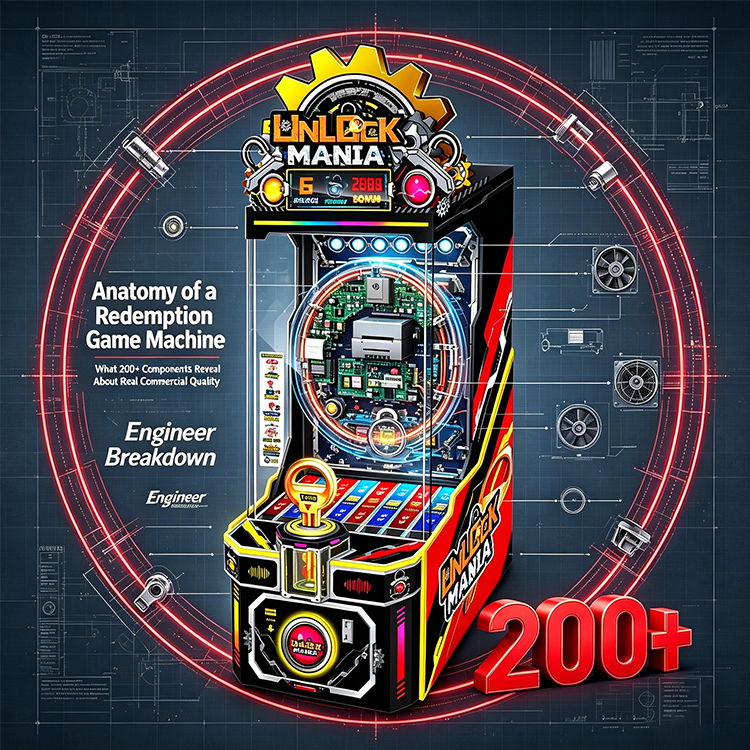
Anatomy of a Redemption Game Machine: What 200+ Components Reveal About Real Commercial Quality
Most arcade equipment buyers evaluate machines the same way: they look at the cabinet artwork, the display, the LED lighting, and the payout ratio on the spec sheet. That’s the wrong evaluation model — and it’s the reason so many first-time importers regret their purchase 14 months later, when the coin acceptor jams for the fourth time in a week and the local technician tells them “the parts aren’t available.”
A commercial-grade redemption game machine components between 180 and 260 discrete components depending on the game type. Only about a dozen of them are visible from the outside. The other 95% determine whether the machine will earn revenue for 5 years or become a maintenance headache in 18 months.
This article walks through the actual construction of a redemption game machine from the perspective of Sunflower Amusement’s design and systems engineering teams — the people who make component-level decisions during development. It is written for investors, procurement managers, and distributors who want to understand what they are actually buying before they sign a purchase order.
The Buyer’s Blind Spot
Buyer perspective — the pattern we see every month: A new FEC investor visits three arcade trade booths. All three show the same category of machine: a mid-size ticket redemption skill game. The quoted FOB prices are USD 2,800, USD 3,600, and USD 4,900. The cabinets look nearly identical. The gameplay demos feel similar. The buyer picks the USD 2,800 unit because “the specs are the same.”
Six months later, the machine’s motor stops working under continuous commercial load. The distributor cannot source the exact replacement motor because the factory used a generic no-brand unit sourced from a spot market. The machine sits idle on the floor for 3 weeks. Lost revenue: USD 1,400. Total repair cost: USD 380. And the same problem will happen again — because the underlying engineering decision (a USD 8 motor instead of a USD 24 industrial-grade motor) has not changed.
The USD 2,100 saved on the initial purchase has cost the buyer USD 1,780 in the first failure alone. Multiply this by 5 years of operation, and the “cheaper” machine costs 3–4x more than the properly engineered alternative.
Understanding the anatomy of the machine is what prevents this outcome.
Subsystem 1 — The Cabinet: More Than a Box
Design engineer perspective: The cabinet is the foundation of the entire machine. Everything else bolts to it, plugs into it, or hangs from it. It also absorbs 100% of the physical abuse a machine takes on a commercial floor — kicks, drink spills, ticket-pulling force, cleaning chemicals, and 24/7 vibration from adjacent machines.
A commercial-grade redemption game machine components is built from:
18mm high-density MDF (medium-density fiberboard)
- for structural walls — not 12mm particle board, which is common in consumer-grade or cost-cut commercial units. The 6mm difference matters: 18mm MDF withstands 3–4x the impact force before permanent deformation.
Fire-rated coating
- meeting EN 13501 Class B-s1,d0 (EU) or ASTM E84 Class A (US). Commercial venues almost always require fire-rated interior materials.
Steel corner brackets
- at every internal joint. In cost-reduced designs, these are replaced with plastic corner blocks that fail after 3–5 years of vibration.
UV-stable acrylic panels
- (typically 5–8mm thickness) for the play field windows. Standard acrylic yellows within 18 months under FEC LED lighting; UV-stable acrylic maintains clarity for 6–8 years.
Powder-coated steel service doors
- with heavy-duty locks (usually T-handle cam locks rated for 100,000+ cycles).
How to inspect the cabinet as a buyer: Ask the factory for a photo of the internal cabinet joints before assembly. Real commercial construction shows steel corner brackets, screwed and glued joints, and visible reinforcement at load-bearing points. Cost-cut construction shows stapled joints and plastic corner pieces.
Subsystem 2 — The Mechanical Assembly
This is the heart of what makes a redemption game feel physical and satisfying. Different game categories have different mechanical assemblies, but the engineering principles are identical.
Motors and Actuators
Systems engineer perspective: A single commercial redemption game contains between 3 and 12 motors depending on the game type. In a mid-complexity skill game, you’ll typically find:
- 1x main gameplay motor (moves the target, spinner, or wheel)
- 1x ticket dispenser motor
- 1x coin/token return motor
- 2–4x auxiliary motors for lighting effects, secondary movement, or reset mechanisms
The critical distinction is duty cycle rating. Consumer-grade motors are rated for intermittent use (a few hours per day). Commercial-grade motors are rated for 24/7 continuous operation with a specified Mean Time Between Failures (MTBF).
At Sunflower Amusement, our standard main gameplay motor spec is:
MTBF ≥ 50,000 hours
- (equivalent to 5.7 years of continuous operation)
IP54 dust and moisture rating
- to survive spilled drinks and dust accumulation
12V or 24V DC brushless
- — brushless motors have no carbon brushes to wear out, which is the single most common motor failure mode in cost-cut machines
The price gap between a proper commercial motor and a “close enough” generic motor is USD 12–35 per unit. Multiplied across 12 motors, that’s USD 150–420 per machine — and it’s exactly where cost-cut manufacturers save money.
Sensors and Position Detection
Every mechanical movement in a redemption game is monitored by sensors. The sensors tell the game logic:
- Where the target is
- Whether a coin or token has been inserted
- Whether a ball has passed through a scoring gate
- Whether the ticket dispenser has jammed
- Whether the cabinet door has been opened (anti-tamper)
A typical commercial redemption game contains 8–20 sensors. The two most common types:
Infrared photoelectric sensors
- — non-contact, no wear, 5–7 year lifespan when properly shielded
Reed switches or Hall-effect sensors
- — used for position detection, extremely reliable when the paired magnet is correctly specified
The failure pattern in cost-cut machines: Cheap sensors are typically un-shielded and get triggered by ambient light interference (from LED cabinet lighting or the sun through nearby windows), producing false-positive scoring and paying out incorrect ticket amounts. The operator loses money on every game cycle without knowing why.
Ticket Dispensers: The Highest-Failure Component
Ticket dispensers are the most operationally critical mechanical subsystem in the entire machine, and they are also the most commonly compromised in cost-cut designs.
Systems engineer perspective: A commercial-grade ticket dispenser is expected to reliably dispense 500,000+ ticket cycles before requiring service. It must handle:
Paper ticket stock variability
- (thickness, curl, moisture content)
Ticket jam detection and recovery
- (the machine must know when it’s jammed and stop dispensing, not continue counting phantom tickets)
E-ticket (RFID cashless) integration
- — modern dispensers must interface with the venue’s cashless system and report ticket counts to the central server
Industry-standard commercial ticket dispensers (Deltronic Labs, Entropy, and equivalent) cost USD 65–140 per unit at wholesale. Cost-cut generic dispensers cost USD 15–35 and typically fail within 200,000 cycles — which is 6–12 months of commercial operation.
At Sunflower Amusement, our standard-fit ticket dispenser is a proven commercial-grade unit with jam sensing and full e-ticket compatibility. This choice adds about USD 90 to the machine cost — and prevents the single most frequent maintenance call our distributors report from their end-customers.
Subsystem 3 — The Electronics Package
Systems engineer perspective: The electronics inside a commercial arcade machine are typically organized around three boards:
The Main Game PCB (Printed Circuit Board)
This is the machine’s brain. It runs the game logic, controls all motors and sensors, tracks the ticket payout algorithm, and communicates with the cashless system.
Component-level quality differences:
Board layer count
- : 4-layer PCBs are the commercial minimum; 6-layer is standard for high-reliability designs. 2-layer boards (found in cost-cut units) suffer signal interference in the high-EMI arcade environment.
Capacitor grade
- : Japanese or Taiwanese-manufactured capacitors (Rubycon, Nichicon, Nippon Chemi-Con, Panasonic) last 8–12 years at commercial temperatures. Generic Chinese capacitors from the spot market can fail in 18–24 months, particularly the electrolytic capacitors in the power section.
Microcontroller sourcing
- : Genuine STMicroelectronics, Renesas, or Microchip MCUs vs. gray-market or refurbished MCUs. The gray-market savings is USD 3–8 per board; the failure risk is 5–10x higher.
The I/O Interface Board
This board translates between the main game PCB and all the mechanical/sensor subsystems. It contains:
- Motor driver ICs
- Optocouplers for signal isolation (critical in a high-noise environment)
- Screw terminals and JST-XH connectors for cable connections
- Fuses and TVS diodes for surge protection
How this fails in cost-cut designs: Missing optocouplers means voltage spikes from motor turn-off can damage the main PCB. Missing fuses means a shorted motor takes out the entire board. Missing surge protection means a lightning strike near the venue destroys every machine on the network.
The Power Supply Unit (PSU)
This is where cost-cut manufacturers save the most money and buyers pay the most in long-term reliability.
Commercial-grade PSU
- : 80+ Bronze or Gold rated, 100,000+ hour MTBF, over-voltage / over-current / over-temperature protection, active PFC. Cost: USD 45–90.
Cost-cut PSU
- : No efficiency rating, no MTBF specification, minimal protection circuits. Cost: USD 12–25.
A failing PSU takes down the entire machine. Replacement time (finding the exact voltage/current rating replacement) can be days to weeks in export markets. Every hour of downtime is lost revenue.
Subsystem 4 — Coin / Bill / Cashless Payment Interface
Systems engineer perspective: The payment acceptance layer is where the machine meets the money — and where compromised components directly cost the operator revenue.
Coin Acceptors
Commercial standard: CH-926 multi-coin acceptor (or equivalent). Programmable for local currency, rejects slugs and fake coins with 99%+ accuracy. Cost: USD 18–35.
Cost-cut alternative: Fixed single-coin comparator. Cost: USD 4–8. Rejects fake coins with 70–85% accuracy, meaning the operator loses 15–30% of coin revenue to slugs and washers over the machine’s life.
Bill Validators
For markets that accept banknotes, the standard commercial validators are ICT L83, ITL BV20/BV50, or JCM Vega. These carry firmware updates for new banknote series, have 99.5%+ acceptance rates, and support stacker cassettes. Cost: USD 180–380.
Cost-cut alternative: Generic no-brand validators with fixed firmware. They cannot be updated when a country issues a new banknote series (which happens every 3–7 years in most currencies), effectively becoming useless.
Cashless / RFID Card Interface
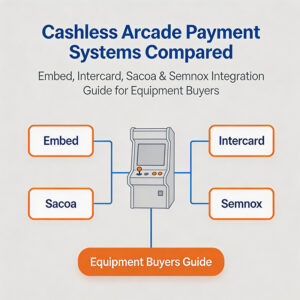
Modern arcade operations increasingly run on cashless systems (Embed, Intercard, Sacoa, Semnox). The machine’s cashless interface must be compatible with the venue’s system.
At Sunflower Amusement, our standard cashless-ready design supports the IATP (International Amusement Tokenization Protocol) and includes physical mounting positions for all major cashless reader brands. Machines that require custom retrofitting for cashless integration cost operators USD 200–500 per unit in labor and integration work.
Subsystem 5 — Sound, Lighting, and Display
Design engineer perspective: These subsystems don’t affect reliability directly, but they affect the machine’s “earn rate” — how much revenue the machine generates per hour on the floor.
LED lighting
- : Commercial-grade LED strips (5050 SMD, minimum 3000 lm/m) with proper current limiting last 8–10 years. Cheap LED strips fail (dead pixels, color shift, complete failure) within 2–3 years.
Audio amplifier and speakers
- : A machine that sounds tinny or muffled gets ignored on a crowded arcade floor. Commercial audio subsystems use 15–30W amplifiers driving 8-inch full-range speakers. Cost-cut units use 3W amplifiers and 4-inch mylar speakers.
Displays (LCD)
- : Commercial-grade LCDs are rated for 60,000+ hours of continuous operation with anti-glare treatment. Cost-cut units use consumer LCD panels that develop burn-in and dead pixels within 2 years.
The Total Component Count: Why It Matters
Adding up the subsystems, a typical Sunflower Amusement mid-complexity redemption machine contains approximately:
| Subsystem | Component Count |
| Cabinet & structural | 45–65 pieces |
| Mechanical (motors, gears, actuators) | 25–40 pieces |
| Sensors | 8–20 pieces |
| PCBs and electronic modules | 4–8 boards + supporting components |
| Wiring harnesses and connectors | 30–60 pieces |
| Payment interface | 3–8 pieces |
| Lighting and display | 15–30 pieces |
| Cabinet artwork, decals, and finishing | 10–20 pieces |
| Total | ~180–260 components |
Every one of these components represents a decision: commercial-grade or cost-cut. The manufacturer that saves USD 5 per component across 200 components has saved USD 1,000 per machine — most of which is coming out of the buyer’s long-term reliability.
What Distributors and Investors Should Ask Before Buying
Based on 16 years of factory experience shipping to distributors worldwide, these are the questions that separate serious buyers from those who will regret the purchase:
“Can you provide a BOM (Bill of Materials) with component brands specified?”
1. Serious commercial manufacturers can. Cost-cut factories cannot or refuse.
“What is the MTBF specification for the main motor and ticket dispenser?”
2. No specification = generic components with unpredictable reliability.
“Are the capacitors on the main PCB Japanese-brand?”
3. This one question filters out about 80% of cost-cut manufacturers.
“What is your standard warranty period, and what does it cover?”
4. Real commercial warranties cover the PCB and motors for 12+ months. Warranty-free machines are a red flag.
“Can I purchase original spare parts 3, 5, and 7 years from now?”
5. Manufacturers who stock legacy parts prove long-term commitment.
The Sunflower Amusement Engineering Standard
At Sunflower Amusement, we’ve built our reputation over 16 years by making the component-level decisions that protect our distributors’ end-customer relationships. Every machine that leaves our factory:
- Uses commercial-grade PSUs with 80+ efficiency rating
- Ships with Japanese-brand electrolytic capacitors on the main PCB
- Includes commercial-standard ticket dispensers with jam sensing
- Comes with a full 12-month warranty on electronics and motors
- Is supported by original spare parts availability for 7+ years post-production
This is why our distributors report significantly lower service-call rates than industry average — and why FEC operators in the MENA and LATAM regions consistently reorder from Sunflower rather than switching to cost-cut alternatives.
Want to evaluate the engineering behind our machines before committing? Request a BOM overview and warranty documentation or browse our current catalog with confidence in the underlying build quality.
FAQ
Q: How many components are inside a typical commercial arcade machine? A: Between 180 and 260 discrete components depending on the game type. Simple crane machines have 130–180; complex multi-player redemption cabinets can exceed 320.
Q: What is the single most important component in determining long-term reliability? A: The power supply unit (PSU). A failing PSU takes down the entire machine, and PSU quality is where cost-cut manufacturers save the most money. Specify a commercial-grade PSU with 80+ rating minimum.
Q: Why do some manufacturers refuse to share their BOM? A: Because their BOM reveals cost-cut sourcing decisions — generic no-brand components, spot-market capacitors, gray-market ICs. Legitimate commercial manufacturers can share BOM summaries with genuine buyers under NDA.
Q: How do I inspect a machine’s build quality without opening it? A: Ask for photos of the internal wiring harness, the main PCB, and the cabinet corner brackets. Commercial construction is visible: bundled cables with strain relief, clean board layouts, steel structural elements. Cost-cut construction shows loose wiring, cluttered PCBs, and plastic corner blocks.
Q: What is MTBF and why should I care about it? A: MTBF (Mean Time Between Failures) is the statistical average time a component operates before failure. Commercial motors should have MTBF ≥ 50,000 hours (5.7 years continuous). If the manufacturer cannot state MTBF for the main motor, they are using generic components without engineering specifications.
Q: Are Japanese-brand capacitors really that different from Chinese generic capacitors? A: Yes, significantly. Japanese electrolytic capacitors (Rubycon, Nichicon, Panasonic) have well-documented 8,000–10,000 hour ratings at 105°C. Generic Chinese spot-market capacitors often carry rated specs but fail early due to inconsistent electrolyte quality. This is the single most common cause of PCB failure in cost-cut machines.
Internal Link Suggestions:
- → BOM Breakdown: Chinese vs Japanese Component Sourcing (Article 8)
- → 18-Month Redemption Game Development Process (Article 9)
- → How to Vet a Redemption Game Supplier
- → Product Catalog: Commercial Redemption Machines

Add comment