


Introduction
There is a shift underway in how people choose entertainment venues — and it has significant implications for how FEC operators invest in their game floors.
The post-pandemic consumer places premium value on shared experiences. Birthday parties, corporate team outings, family reunions, school field trips — these group occasions represent not just higher per-visit spending but a fundamentally different booking intent. A solo visitor decides spontaneously. A group coordinator decides weeks in advance, spends more, and is far more likely to leave a review.
Multi-player redemption games are the category that captures this shift most directly.
What Makes a Redemption Game “Multi-Player”?:
True multi-player redemption games are designed so that 2–6 players interact with the same game system simultaneously — competing, cooperating, or both — and all players earn or share ticket payouts based on collective or competitive outcomes.
The defining characteristic is social interaction within a single play session. Players watch each other, cheer, compete, and share the emotional payoff of wins and near-misses. This dynamic creates memories — and memory is the engine of return visits.
The Group-Play ROI Case — Four Data Points That Matter:
- Revenue Per Play Session
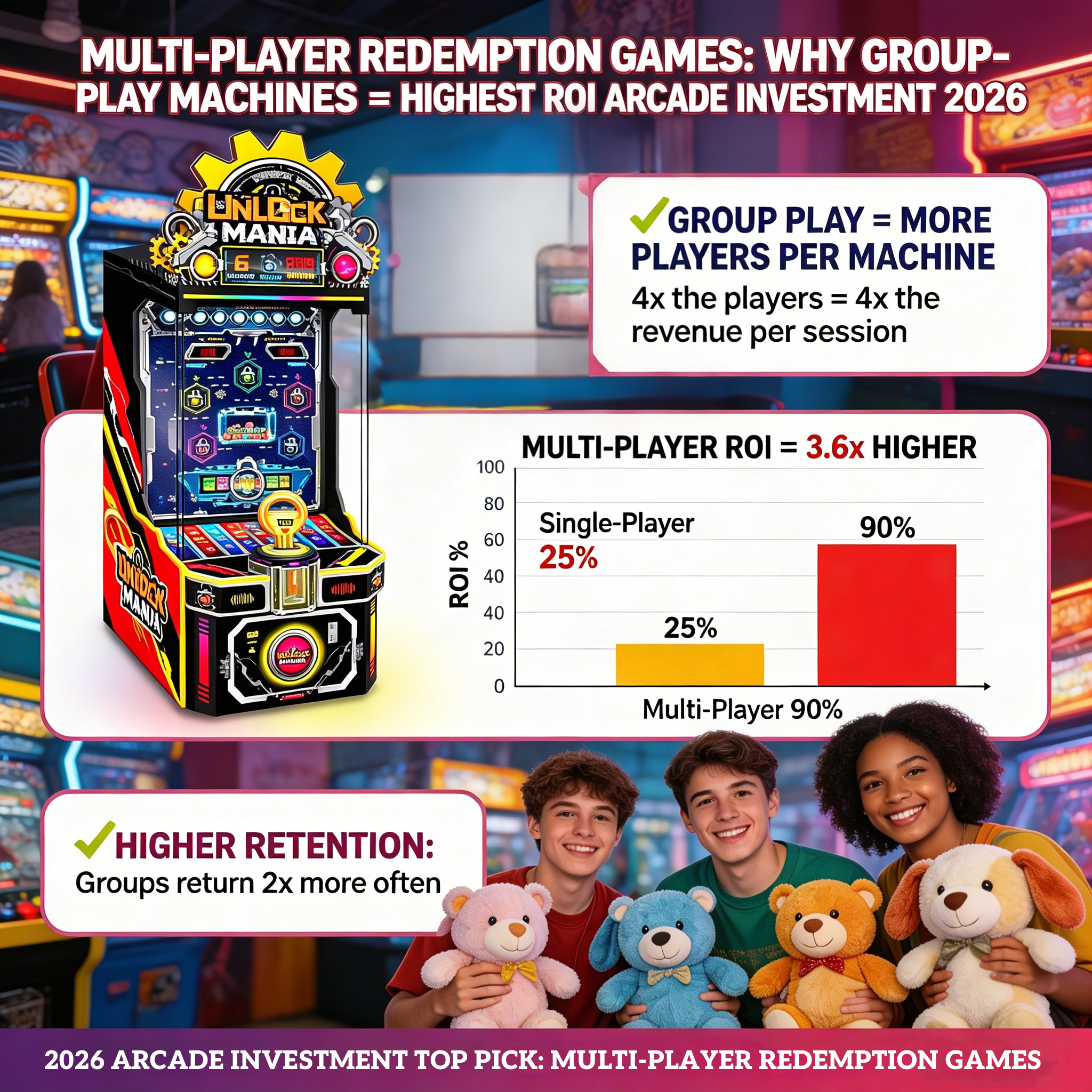
A multi-player coin pusher operating at full capacity (4 players) at $1 per credit generates 4x the per-session revenue of a single-player machine at the same price point. Even at partial capacity — 2–3 players — the revenue-per-session advantage is substantial.
- Dwell Time Extension
Internal operator data from mid-size FECs consistently shows that guests who engage with multi-player machines spend 25–40% more time on the floor than guests who only play single-player games.
- Group Booking Conversion
Venues that prominently feature multi-player redemption games — and market them in group booking packages — report higher party and event booking rates.
- Social Media Amplification
Multi-player games generate spontaneous, shareable moments. A group of four friends erupting over a near-win on a coin pusher is inherently more shareable than a solo player completing a skill game. This earned media effect reduces paid marketing costs and generates referral traffic.
Top Multi-Player Redemption Machine Categories for 2026:
Group Coin Pusher Machines:
The multi-player coin pusher remains the most consistently high-performing group-play category. Its mechanics are immediately intuitive and the variable reward structure triggers strong engagement.
What to look for in a commercial-grade unit:
- Simultaneous 4-player configuration
- Operator-adjustable payout ratios
- Durable coin feed mechanisms rated for 100,000+ cycles
- LED lighting systems that respond to gameplay events
- Cabinet dimensions compatible with standard FEC floor layouts
Competitive Skill Redemption Games:
Head-to-head skill games create high-intensity engagement moments that generate crowd attention. Air hockey variants with ticket payouts, competitive ball-drop games, and racing redemption cabinets fall into this category.
Cooperative Group Challenge Machines:
An emerging format in 2025–2026 where 3–6 players work together to achieve a shared goal, with the ticket payout awarded to the group collectively. Particularly effective for family groups, corporate outings, and school group visits.
Digital Integration — Scan-to-Play and App-Linked Group Games:
The most forward-looking multi-player redemption machines in 2026 incorporate QR code scan-to-join mechanics, app-linked leaderboards, and digitally tracked ticket balances. For distributors and operators evaluating suppliers, ask specifically whether the manufacturer’s product roadmap includes digital integration.
Evaluating a Group-Play Machine Supplier:
- Can they demonstrate the machine with multiple simultaneous players?
Request a video demo showing the machine operating at full player capacity.
- What is the failure rate on player interface components?
In a multi-player machine, the player interfaces experience multiple times the wear of a single-player unit. Ask for MTBF data on these components specifically.
- What does the ticket payout algorithm look like at full capacity?
Confirm that payout parameters are independently adjustable per player station.
- Is the software configurable for different group sizes?
The best machines allow operators to run the game in 2-player, 3-player, or 4-player modes.
Building a Group-Play Zone — Layout and Merchandising Recommendations:
A dedicated group-play zone creates a powerful anchor for group booking marketing.
- Minimum zone size: 400–600 sq ft for a 3–4 machine cluster
- Open perimeter: Leave spectator space — the crowd is part of the experience
- Clear sightlines from the entrance: Use height, lighting, and audio to draw attention
- Signage for group packages: Clear in-venue signage that connects the zone to party/event booking
- Staff positioning: A team member visible in the zone reduces new-player hesitation
Sunflower Amusement’s Multi-Player Lineup:
Sunflower Amusement manufactures a range of multi-player redemption machines engineered for commercial FEC deployment — including multi-station coin pusher cabinets, competitive dual-player skill games, and large-format group challenge machines. All units ship with operator-adjustable ticket payout parameters, CE certification, and English-language maintenance documentation.
OEM and branded versions are available for distributors building proprietary product lines, with flexible MOQ options for regional distributors entering new markets.
CTA: Explore multi-player redemption machines for your venue. View the group-play product range at https://www.sunfloweramusements.com/shop/ or contact Sunflower Amusement at https://www.sunfloweramusements.com/contact-us-amusement-machine-manufacturer-wholesale/ to request specifications and wholesale pricing.
FAQ:
Q: What is the ideal group size for multi-player redemption games?
A: Most commercial multi-player redemption machines are designed for 2–6 players. The sweet spot for revenue efficiency is 3–4 players.
Q: Do multi-player machines require more maintenance than single-player units?
A: Yes — with multiple player interfaces, the cumulative wear is higher. The key is sourcing from a manufacturer who supplies original replacement parts quickly and provides clear maintenance documentation.
Q: How do multi-player redemption games support party and event bookings?
A: Group-play machines are highly marketable as part of party packages — they give the birthday group something to do together and create a clear differentiator from venues that only offer single-player games.
Q: Are multiplayer redemption machines suitable for younger children?
A: Cooperative formats work very well for mixed-age family groups including young children. Competitive head-to-head formats are better suited for older children (8+) and adults.
Q: What ticket payout rates are typical for multi-player redemption games?
A: This varies significantly by machine type, price-per-play, and operator configuration. Most commercial machines allow ticket payout ratios to be tuned independently.
Q: Can multi-player redemption games be connected to digital loyalty systems?
A: Increasingly, yes. The leading manufacturers in 2025–2026 are offering machines with QR code integration, app-linked ticketing, and cashless payment compatibility.
Internal Link Suggestions:
→ Link to product category: Product – Sunflower Amusement
→ Link to product category: Sports Games Archives – Sunflower Amusement
→ Link to: About us – Sunflower Amusement
→ Link to: Contact us – Sunflower Amusement
→ Link to:News – Sunflower Amusement


Add comment