


Introduction
Most arcade operators think about game selection. The best operators think about game placement.
The physical layout of your game floor — the sequencing of redemption machines categories, the management of sightlines, the placement of prize counters, the routing of foot traffic — has a measurable impact on revenue per square foot that rivals the performance difference between a mediocre game and a great one.
This guide covers the spatial and psychological principles behind high-revenue FEC floor layouts, with specific guidance on how to position redemption game machines to maximize time-on-floor, ticket spending, and repeat visits.
The Revenue-Per-Square-Foot Equation:
Before placing a single machine, operators should understand their floor economics. Revenue per square foot is calculated simply:
Revenue per sq ft = Total game floor revenue ÷ Total game floor area
Industry benchmarks for productive FECs typically range from USD 80 to USD 200+ per square foot annually. Layout decisions — not just machine quality — determine where on that range your venue lands.
The layout affects three key behavioral metrics:
- Dwell time — how long a guest stays on the floor
- Spend rate — how quickly they convert their card or token balance
- Return frequency — whether they come back next week
Redemption games, when correctly positioned, drive all three metrics simultaneously.
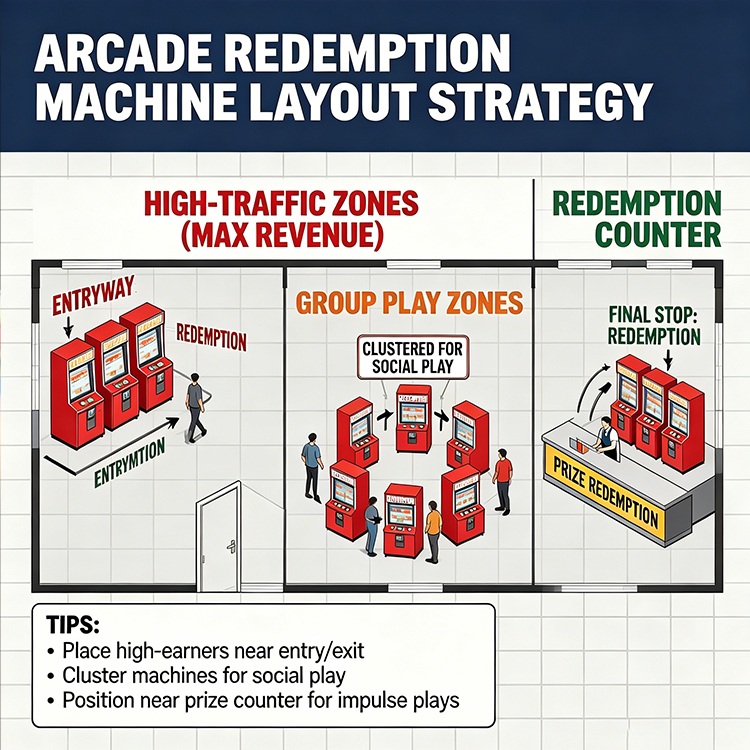
Zone Architecture: The Three-Zone Framework:
Zone 1 — The Arrival Experience (Hook Zone)
The moment a guest enters, they need a visual and auditory reason to move forward. This zone should feature:
- High-energy, high-visibility machines with bright displays, active lighting, and crowd-attracting sound effects
- Multiplayer or large-format cabinets that draw groups and generate social proof
- Medium ticket-payout games that offer early wins and prime the reward loop
This is not where you place your highest-revenue-per-play machines. It is where you convert hesitant entry into committed engagement.
Zone 2 — The Revenue Core (Engagement Zone)
The center of your floor should contain your highest-earning machines:
- Skill-based redemption games with variable reward mechanisms
- Coin pusher and mechanical redemption machines with strong tactile appeal
- Themed or IP-licensed machines that encourage photo sharing and extended play sessions
This zone benefits from a slightly lower ceiling height or a defined perimeter that creates a sense of arrival.
Zone 3 — The Anchor Zone (Retention and Redemption)
The rear or perimeter of the floor serves a dual purpose:
- Prize redemption counter — always visible from Zone 2, always back-lit and well-stocked
- Lower-stimulation games for younger children and families
- Seating areas adjacent to games, encouraging groups to linger
The prize counter should never be an afterthought. It is the physical embodiment of the reward loop.
Traffic Flow — Managing the Path of Least Resistance:
Guests follow paths of least resistance. If your floor layout creates visual dead ends or ambiguous entry points, guests will not explore.
Design for circulation:
- Maintain 5–6 feet of clear aisle space between machine rows
- Use curved or angled machine groupings rather than strict grid layouts
- Position your most attractive machines so they are visible from multiple points on the floor
Sound management:
- Group machines with compatible audio profiles
- Avoid placing silent machines next to high-decibel action games
Lighting cues:
- Brighter overhead lighting in active zones; dimmer ambient in the core creates immersion
- LED accent lighting on prize counters increases dwell time
Redemption Machine Placement by Category:
| Machine Category | Best Placement | Why |
| High-energy action redemption | Zone 1 / entrance area | Visual magnetism, audio draw |
| Skill-based coin pusher | Zone 2 center | Variable reward encourages repeat play |
| Multiplayer group redemption | Zone 1 or Zone 2 perimeter | Social proof, group booking appeal |
| Classic crane / prize vending | Adjacent to prize counter | Reinforces redemption behavior |
| Children’s redemption games | Zone 3 perimeter | Separation from high-stimulation zones |
| Sports simulation with redemption | Zone 2 / feature position | High play value, natural audience gatherer |
The Ratio Question — How Many Redemption Machines ?:
Industry experience places the optimal redemption game ratio at 40–60% of total machines for venues targeting family and mixed-age demographics. Redemption games in a well-designed FEC typically generate 50–70% of total game revenue from a well-curated selection.
Seasonal Layout Adjustments:
Top-performing FEC operators treat the game floor as a living asset:
- Rotate featured machines between Zone 1 and Zone 2 quarterly
- Create seasonal zones that justify marketing campaigns and give guests a reason to return
- Remove underperforming machines decisively rather than letting low-earn units occupy prime square footage
CTA: Plan your game floor with the right machines. View the full redemption game catalog at https://www.sunfloweramusements.com/shop/ or contact our sales team at https://www.sunfloweramusements.com/contact-us-amusement-machine-manufacturer-wholesale/ to discuss layout-specific product recommendations.
FAQ:
Q: How do I calculate revenue per square foot for my arcade?
A: Divide your total monthly game floor revenue by the number of square feet dedicated to games. Track this monthly and compare against industry benchmarks of USD 6–16 per sq ft per month for productive FEC floors.
Q: Should the prize redemption counter be near the entrance or the back?
A: Near the back is the standard approach — it pulls guests through the floor and increases exposure to machines they would otherwise walk past.
Q: How often should I rotate machine positions?
A: Most operators rotate featured machines every 60–90 days. The goal is to create novelty for repeat visitors.
Q: What is the minimum aisle width for a commercial game floor?
A: 5 feet (approximately 150 cm) is the operational minimum. For high-traffic zones or venues accommodating strollers and wheelchairs, 6–7 feet is recommended.
Q: Do multiplayer redemption games require more floor space?
A: Yes — but they often earn more per square foot because they serve 2–6 players simultaneously, making the space economics highly favorable.
Internal Link Suggestions:
→ Link to product category: Product – Sunflower Amusement
→ Link to product category: Prize Games Archives – Sunflower Amusement
→ Link to: About us – Sunflower Amusement
→ Link to: Contact us – Sunflower Amusement



Add comment