


Introduction
Delayed shipments, missing spare parts, uncertified electronics — these problems compound quickly on a live game floor. Yet most buyers still make sourcing decisions based on a product catalog and a quoted price.
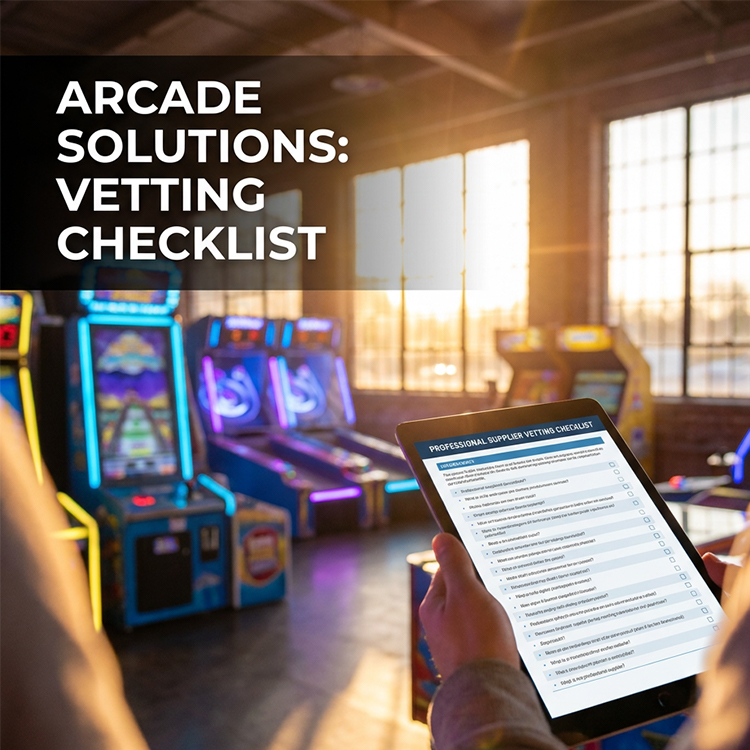
This guide lays out the exact seven-point framework that experienced FEC operators, arcade distributors, and indoor playground investors use when evaluating a new redemption game supplier — before the first purchase order is signed.
Why Supplier Vetting Matters More Than Machine Specs
A redemption game machine is a piece of commercial equipment that must run reliably for tens of thousands of cycles under real-world conditions: sticky fingers, spilled drinks, rough handling. The machine’s spec sheet tells you what it can do on day one. The redemption game supplier’s track record tells you what happens on day 180.
The global ticket redemption game machine market reached USD 295 million in 2024 and is projected to grow to USD 391 million by 2030. That growth is attracting new entrants — some credible, many not. Knowing how to separate factory-grade manufacturers from trading companies masquerading as manufacturers is the single most valuable sourcing skill a buyer can develop.
The 7-Point Supplier Vetting Checklist:
1. Factory Verification: Manufacturer vs. Trading Company
What to look for: Does the redemption game supplier actually manufacture the machines, or do they source from third-party factories and add a margin?
Factory-direct redemption game supplier control production quality, lead times, and spare part availability. Trading companies cannot. Ask directly: “Can we schedule a factory video call or site visit?” Legitimate manufacturers will say yes immediately. Request photos of the production floor, assembly line, and warehouse — timestamped and with your product visible if possible.
- Green flags: In-house R&D team, mold shop, PCB design capability, dedicated QC line.
- Red flags: Catalog-heavy presentations, unwillingness to show production footage, delivery quotes that vary suspiciously by week.
2. Certifications: CE, RoHS, ISO and What They Actually Mean
For North American and European buyers, CE certification is non-negotiable. It confirms the machine meets EU electrical safety, EMC, and mechanical safety standards. Without CE, your machines may be stopped at customs or trigger liability issues if a player is injured.
RoHS compliance matters for markets with strict environmental import controls. ISO 9001 certification indicates a quality management system — not just a promise of quality, but a documented, audited process.
Ask for the actual certificate documents, not logos on a website. Cross-check the certificate number against the issuing body’s public registry.
Key certifications to request:
- CE (mandatory for EU/UK markets)
- RoHS (electronic waste compliance)
- ISO 9001 (quality management)
- FCC or UL (if sourcing for the US market)
- Local country-specific compliance as needed
3. Product Range Depth: Can They Grow With You?
A redemption game supplier capable of delivering only a narrow category of machines limits your future flexibility. The best partners offer a full range: skill-based redemption games, coin pusher machines, sports simulators, prize vending units, and group-play cabinets. This lets you diversify your game floor from a single trusted source.
Ask about their new product release cadence. A redemption game supplier or manufacturer with a healthy R&D investment typically launches 5–10 new models per year. Stale catalogs signal reduced innovation investment — and a factory that may be struggling.
4. MOQ and Customization Flexibility
Minimum order quantities (MOQs) tell you a lot about a supplier’s operational flexibility. Large MOQs may indicate a factory geared toward volume-only buyers, while flexible MOQs suggest a manufacturer willing to support distributors and new-market entrants.
Equally important is OEM/ODM capability. Ask:
- Can you produce machines with our brand name and logo?
- Can we request custom cabinet designs, color schemes, or theme wraps?
- Can software game parameters (ticket payout ratios, difficulty levels) be adjusted?
Customization capability separates suppliers who simply ship boxes from partners who help you build a branded venue.
5. After-Sales Support Structure
This is the single most underrated evaluation criterion. When a machine breaks down on a Friday night with 200 players on the floor, you need resolution in hours — not weeks.
Questions to ask during vetting:
- Do you supply original spare parts, and what is your lead time?
- Is there a technical support team available via WhatsApp, WeChat, or email?
- Do you provide maintenance manuals and video tutorials in English?
- What is your warranty period and what does it cover?
A manufacturer that stocks original components and offers English-language technical documentation is demonstrably more valuable than one with a lower unit price but slow post-sale response.
6. Production Capacity and Lead Time Reliability
Ask for a straight answer: “What is your current production lead time for a 20-unit order?” Then ask: “What happens if raw material costs spike or there is a factory holiday?” Experienced buyers verify these answers against LinkedIn reviews, trade fair histories, and references from existing distributor partners.
Understand the factory’s capacity ceiling. A small operation may struggle with urgent reorders during your peak season. Confirm whether the factory operates continuous shifts and what buffer stock they maintain for popular SKUs.
7. References and Portfolio Evidence
Request two or three contact references from current distributors or FEC operator clients — in markets similar to yours. A reputable manufacturer will provide them without hesitation. Ask those references specifically about:
- Accuracy of promised lead times
- Ease of communication with the export/sales team
- Handling of a product defect or replacement claim
- Overall satisfaction 12 months post-purchase
Additionally, review the supplier’s presence at major trade events such as IAAPA Expo, GTI, and DEAL. Consistent trade show participation signals a manufacturer that is serious about the global market.
Putting It Together: A Weighted Evaluation Matrix
| Criterion | Weight | Questions to Ask |
| Factory verification | 20% | Manufacturing footage, R&D team, production visit |
| Certifications | 20% | CE, RoHS, ISO — document and verify |
| Product range | 15% | Category breadth, annual new releases |
| MOQ & customization | 15% | OEM/ODM options, parameter flexibility |
| After-sales support | 20% | Parts availability, response time, documentation |
| Lead time reliability | 5% | Capacity, buffer stock, holiday planning |
| References | 5% | Distributor contacts, trade show presence |
Sunflower Amusement Clears All Seven Criteria:
Sunflower Amusement has operated as a factory-direct redemption game manufacturer since 2010, with in-house R&D, CE and ISO-certified production, and a product line spanning over 100 SKUs across redemption, prize, and sports game categories. Original spare parts ship within 3–5 business days globally, and English-language technical support is available via direct messaging channels.
OEM and ODM orders are accepted with flexible MOQ thresholds designed specifically to support new distributors and regional resellers entering emerging markets.
CTA: Ready to start the evaluation process? Browse the full redemption game product range at
https://www.sunfloweramusements.com/shop/
or submit an inquiry at
https://www.sunfloweramusements.com/contact-us-amusement-machine-manufacturer-wholesale/
and receive a factory quote within 24 hours.
FAQ:
Q: What is the difference between a redemption game manufacturer and a trading company?
A: A manufacturer produces machines in their own factory, controlling quality, lead times, and parts supply. A trading company resells machines from third-party factories and adds a margin — typically with less accountability when problems occur.
Q: Is CE certification mandatory for all markets?
A: CE is mandatory for the EU and UK. North American buyers should look for FCC or UL certification depending on the state. Middle Eastern buyers often require SASO or G-Mark. Always confirm the required certifications for your destination market before ordering.
Q: How do I verify a CE certificate is real?
A: Request the full certificate document including the issuing notified body’s name and certificate number. Cross-reference the number against the EU’s NANDO database (ec.europa.eu/growth/tools-databases/nando/).
Q: What MOQ is typical for a new distributor placing a first order?
A: This varies significantly by manufacturer and machine type. Established factory-direct suppliers like Sunflower Amusement offer flexible MOQ options for first-time distributors — contact the sales team directly to discuss your specific volume and budget.
Q: How long do redemption game machines typically last?
A: With regular maintenance and access to genuine spare parts, a commercial-grade redemption machine built to CE and ISO standards should deliver 5–8 years of reliable operation under daily commercial use.
Internal Link Suggestions:
→ Link to product category page: Ticket Redemption Games (https://www.sunfloweramusements.com/shop/)
→ Link to: About us – Sunflower Amusement
→ Link to: Contact us – Sunflower Amusement
→ Link to: Product – Sunflower Amusement

Add comment