

The second venue is where an operator’s equipment strategy is decided, usually without anyone realising a strategic decision is being made.
The typical sequence: venue one opens with a machine mix assembled from whatever looked good at the time. Venue two opens eighteen months later, sourced from a different supplier at a better price, with a different cashless platform and a different machine mix because the site is a different shape. Venue three repeats the pattern.
By venue five, the operator is running four cashless platforms, six suppliers, and a spare parts problem that has become genuinely unmanageable: 140 machines across 90 distinct models, no pooled parts inventory, no transferable staff training, and no ability to negotiate meaningful volume pricing with anyone.
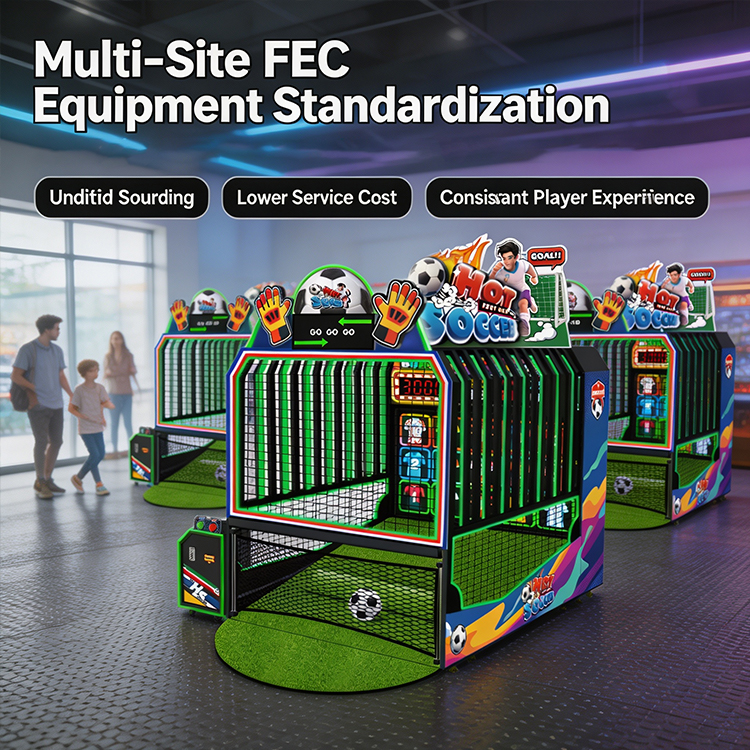
The alternative — standardising the equipment platform from venue two onward — is not about making every venue identical. It is about deciding which elements must be common and which can vary, and then holding that line. Operators who do this consistently report materially lower procurement cost, dramatically lower service cost, and faster new-venue opening timelines.
This guide explains how to structure a standardised multi-site equipment programme, what to standardise versus localise, the savings available at different chain sizes, and how to negotiate the supplier relationship that makes it work. Written from Sunflower Amusement’s perspective supplying chain and franchise operators across MENA, LATAM and EU markets.
The Buyer’s Second-Venue Decision
Perspectiva do comprador: An operator with one successful FEC in Mexico City is opening a second in Guadalajara. His instinct is to shop the market again — a different supplier has quoted 9% below his original cost. On a 45-machine order that is roughly USD 14,000 of apparent savings, and the machines look comparable.
What that calculation omits: two spare parts inventories instead of one pooled stock, two sets of service documentation, staff whose training does not transfer between venues, two warranty relationships, and the permanent loss of volume leverage with either supplier because his purchasing is now split.
Perspectiva do engenheiro de design da Sunflower: We see both patterns clearly in our chain customers. Operators who standardise typically place larger consolidated orders, reach higher discount tiers, hold a single pooled parts inventory, and open new venues faster because the configuration is already proven. Operators who chase the lowest per-order price venue by venue end up with the highest total cost of ownership across the chain — the savings are real but small, and the fragmentation costs are larger and permanent.
The decision point is venue two. After venue four, retrofitting standardisation is expensive.
Part 1 — What Standardisation Actually Means
Standardisation does not mean every venue is a clone. A 12,000 sq ft mall anchor and a 3,000 sq ft satellite location genuinely need different machine mixes. The discipline is separating what must be common from what should adapt.
The Three Layers
Layer 1 — Platform Standards (identical across every venue, no exceptions)
These are the decisions that create compounding cost across the chain when fragmented:
| Element | Why it must be common |
| Cashless payment platform | Guest cards work across all venues; one reporting system; one support relationship; pooled reader spares |
| Primary equipment supplier | Volume leverage, single warranty relationship, one documentation set, one engineering contact |
| Electrical and mounting conventions | Same voltage spec, same reader mounting, same power planning method |
| Service documentation and part numbering | Staff and parts transfer between venues without relearning |
| IoT / operational reporting platform | One dashboard across the chain; comparable data between venues |
| Maintenance procedures and schedules | One training curriculum, one PM calendar, one checklist |
Layer 2 — Core SKU Set (present in every venue, quantity scaled to size)
A defined list of 8–14 machine models that appear in every venue at quantities proportional to floor area. These are the proven earners — the models with demonstrated revenue performance and reliability in your market.
Benefits of a core set:
- Spare parts inventory covers the majority of the fleet across all venues
- Technician training applies chain-wide
- Revenue benchmarking between venues is meaningful because the machines are comparable
- Volume ordering of the same SKUs reaches better price tiers
- New venue configuration is a known quantity, not a fresh design exercise
Layer 3 — Local Variation (venue-specific, within defined bounds)
Where genuine site differences justify divergence:
| Variation driver | Legitimate adaptation |
| Floor area | Number of machines; presence of large anchor units |
| Venue type | Hotel/cinema/mall/standalone mix differences (see venue-type selection) |
| Local demographic | Weighting between children’s, teen and adult-oriented machines |
| Ceiling height / access constraints | Substitution of tall anchor cabinets |
| Local prize sourcing | Prize machine mix and prize tier configuration |
| Site-specific attractions | Complementary machines alongside bowling, karting, soft play |
The governing rule: Local variation draws from an approved catalog, not from the open market. The chain maintains a list of approved models; individual venues select from it. This preserves parts commonality while allowing genuine site adaptation.
Part 2 — Building the Core SKU Set
Perspectiva do engenheiro de design da Sunflower: The core set should be derived from data, not preference. Operators who have run venue one for twelve months already have the information needed.
The Selection Method
Step 1 — Rank existing machines by revenue per square foot, not absolute revenue.
A large anchor machine earning USD 900/week occupying 45 sq ft yields USD 20/sq ft/week. A compact redemption unit earning USD 310/week in 12 sq ft yields USD 26/sq ft/week. On a floor-space-constrained site, the compact unit is the better core candidate.
Step 2 — Overlay reliability data.
Cross-reference revenue performance against service events. A high-earning machine with frequent downtime is a poor core SKU because its problems multiply across every venue. Prefer machines in the top revenue quartile e the bottom service-event quartile.
Step 3 — Assess parts commonality.
Models sharing ticket dispensers, coin acceptors, sensors and power supplies reduce total inventory requirement. Ask your supplier explicitly which models share which subsystems — this information is rarely volunteered but is highly valuable.
Step 4 — Confirm long-term availability.
A core SKU must remain purchasable for years, since new venues will need it. Confirm with your supplier that selected models are on a stable production roadmap, not near end-of-life.
Step 5 — Define quantity ratios rather than absolute counts.
Express the core set as proportions, so it scales to any venue size.
Example Core Set Structure
| Categoria | Share of floor | Core models | Notas |
| Single-player redemption skill | 32–38% | 4–5 models | Volume backbone; highest parts commonality |
| Jogo de empurrar moedas para um jogador | 16–20% | 2 models | Strong per-unit revenue |
| Guindaste / venda de prêmios | 14–18% | 2 models | High margin, low service |
| Redenção das crianças | 16–22% | 3 models | Dados demográficos familiares essenciais |
| Multi-player | 8–12% | 1–2 models | Scaled to venue traffic |
| Anchor / feature | 2–6% | 1 model | Present only above a floor-size threshold |
Applied to a 50-machine venue and a 20-machine venue, the same ratios produce appropriately different absolute counts while keeping every machine within the core set.
Part 3 — The Savings, Quantified
Procurement Savings
Volume discount tiers are the most visible saving. Indicative structure for consolidated chain ordering:
| Annual order volume | Typical discount vs single-container pricing |
| 1 container | Baseline |
| 2–3 containers | 3–6% |
| 4–6 containers | 6–11% |
| 7–10 containers | 10–16% |
| 10+ containers with annual commitment | 14–22% |
A three-venue chain replacing 15% of its fleet annually plus opening one new venue can consolidate into 4–5 containers per year, moving from baseline to the 6–11% tier. On USD 400,000 of annual equipment spend that is USD 24,000–44,000.
Additional procurement effects beyond headline discount:
- Freight consolidation — full containers instead of part loads, and fewer shipments
- Single certification cost amortised across more units (significant in Brazil and Mexico)
- Reduced administrative overhead — one supplier relationship, one set of documents, one payment process
Service and Parts Savings
This is where standardisation delivers its largest and least obvious returns.
Pooled spare parts inventory. Three venues each stocking independently for 45 machines might hold roughly USD 4,200 each — USD 12,600 total. A single pooled inventory serving the same 135 machines, where models are common, typically runs USD 6,500–8,000. Saving: USD 4,600–6,100 of working capital, with better coverage because the pooled stock holds more of each high-frequency part.
Transferable technician capability. One training curriculum instead of three. A technician trained on the core set is immediately effective at any venue. Chains can operate a single roving technician across two to four sites rather than needing capability at each.
Faster fault resolution. A part needed at venue two may be in stock at venue one, hours away rather than weeks. This alone materially improves chain-wide uptime.
Lower documentation and onboarding overhead. One service manual set, one PM checklist, one error-code reference.
Opening Speed
| Activity | Non-standardised | Standardised |
| Machine selection and specification | 3–6 weeks | 2–5 days (apply the ratio template) |
| Supplier negotiation | 2–4 weeks | Existing agreement; place order |
| Cashless integration planning | 2–3 weeks | Known configuration |
| Staff training | 3–4 weeks | Existing curriculum, existing trainers |
| Floor layout design | 2–3 weeks | Adapt proven template |
Standardised chains routinely take four to eight weeks out of the new-venue timeline. For an operator whose venue generates USD 20,000+ per week, opening six weeks earlier is worth more than any procurement discount.
Part 4 — Chain Size Thresholds
Perspectiva do engenheiro de design da Sunflower: The right level of formalisation depends on chain size. Over-engineering at two venues wastes effort; under-engineering at eight venues is costly.
Two to Three Venues — Establish the Standard
Priorities:
- Lock the platform layer now: one cashless platform, one primary supplier, one documentation standard
- Define the core SKU set from venue-one performance data
- Establish a single pooled parts inventory at the highest-volume site
- Train one technician who covers all sites
What not to do yet: build formal procurement processes or dedicated roles. The standard itself is the deliverable at this stage.
Four to Six Venues — Formalise and Negotiate
Priorities:
- Negotiate an annual volume agreement with the primary supplier, with a committed volume in exchange for a price tier and priority production slots
- Move to a central parts warehouse with defined replenishment to each venue
- Employ or designate a dedicated chain technician
- Implement chain-wide IoT reporting for cross-venue performance benchmarking
- Introduce an approved-catalog process for local variation requests
Seven to Ten-Plus Venues — Systematise
Priorities:
- Annual equipment planning cycle with a rolling replacement schedule across sites
- Formal SKU rationalisation review annually — retire underperformers, add proven newcomers
- Consider staged direct import rather than buying through a local distributor, if volume justifies it
- Regional technician team with defined coverage areas
- Structured supplier review — quality, delivery performance, service response measured and discussed
- Explore OEM/private-label on core SKUs, which becomes economically viable at this scale
Part 5 — Franchise-Specific Considerations
Franchise operations face an additional constraint: franchisees are independent businesses whose interests only partly align with brand consistency.
What Franchisors Should Mandate
- Cashless platform (guest experience and brand card interoperability depend on it)
- Core SKU set and minimum quantity ratios (brand consistency and guest expectation)
- Approved supplier list (quality floor and negotiated pricing that benefits franchisees)
- Maintenance standards and PM schedule (brand reputation depends on working machines)
- Service documentation and training standards
What Franchisees Should Control
- Local variation selections from the approved catalog
- Prize sourcing and prize tier configuration within brand guidelines
- Local marketing execution
- Staffing decisions
The Structural Advantage to Offer Franchisees
The most effective franchise equipment programmes make compliance commercially attractive rather than merely mandatory:
- Franchisor negotiates chain-wide volume pricing and passes it through — the franchisee gets equipment cheaper than they could buy independently
- Franchisor operates or coordinates a central parts pool franchisees can draw on
- Franchisor provides technician training as part of the franchise package
- Franchisor pre-negotiates payment and lead-time terms
When these are in place, the approved catalog is the cheapest and easiest route for a franchisee, and enforcement stops being a conflict.
Part 6 — Structuring the Supplier Agreement
Perspectiva do engenheiro de design da Sunflower: Chain buyers have leverage that single-venue buyers do not, and most do not use it. These are the terms worth negotiating in an annual agreement.
| Term | What to seek |
| Volume-tier pricing | Committed annual volume in exchange for a fixed discount tier, with retroactive adjustment if volume exceeds the tier |
| Price stability window | Fixed pricing on core SKUs for 12 months, protecting expansion budgeting |
| Production slot priority | Guaranteed slot allocation for chain orders, particularly around Chinese New Year and post-IAAPA congestion |
| Core SKU availability commitment | Written commitment that core models remain in production for a defined period, with advance notice of end-of-life |
| Spare parts terms | Discounted parts pricing, priority dispatch, and a defined air-freight arrangement for emergency parts |
| Extended parts availability | Original parts guaranteed for a defined number of years post-production |
| Configuration support | Supplier assistance modelling machine mix for each new venue at no cost |
| Training provision | Technician training included or at defined cost, refreshable as staff change |
| Design change notification | Written notice before any BOM change affecting a core SKU |
| New product preview | Early access to new models before general release, for evaluation as core SKU candidates |
A note on what not to negotiate away: Some suppliers offer deeper discounts in exchange for exclusivity clauses restricting the buyer from purchasing elsewhere. For a chain, this is usually a poor trade. The value of standardisation comes from your discipline, not from a contractual prohibition, and retaining the freedom to source a specialised machine outside the core set is worth more than the incremental discount.
Sunflower Amusement’s Chain and Franchise Support
Sunflower Amusement supplies multi-venue operators and franchise groups across MENA, LATAM, EU and North American markets, with programme structures built for expansion:
- Core SKU programme — we work with chains to define a core model set with maximum parts commonality, and we disclose which models share which subsystems
- Annual volume agreements with committed price tiers, 12-month price stability on core SKUs, and priority production slot allocation
- Written core SKU availability commitments with advance end-of-life notification, so expansion planning is not disrupted
- Disponibilidade de peças de reposição originais por mais de 7 anos. on every model, with chain parts pricing and priority dispatch
- Venue configuration modelling at no cost — send floor area, venue type and budget for each new site and we will apply your core ratios
- Cashless-ready across all current models with vendor-neutral pulse interface, so chains are not locked to one payment platform
- Chain-wide documentation standard — consistent English service manuals, wiring diagrams and part numbering across all models
- Technician training for chain and franchise service teams
- OEM / private-label programmes on core SKUs for chains at sufficient scale
- New model preview access for chain partners evaluating core SKU additions
Planning venue two, or rationalising an existing chain? Send us your current fleet list and expansion plan and we will map a core SKU set with parts commonality analysis, or browse the catalog to review candidate models.
Perguntas frequentes
Q: Should my second venue have the same arcade machines as my first?
A: The platform layer — cashless system, primary supplier, documentation standard, electrical conventions — should be identical, without exception. The machine mix should draw from a defined core SKU set, with quantities scaled to floor area and a controlled allowance for genuine site differences. Sourcing venue two independently to save 8–9% on purchase price usually costs more in fragmented parts inventory, non-transferable training and lost volume leverage.
Q: How many machine models should a chain standardise on?
A: A core set of 8–14 models covering 80–90% of each venue’s floor typically balances operational simplicity against guest variety. Beyond roughly 14 core models, parts commonality benefits erode; below 8, venues start to feel repetitive to guests visiting multiple sites.
Q: How much does equipment standardisation actually save?
A: Three effects compound. Procurement: consolidated volume moves a growing chain from baseline into the 6–16% discount tier. Parts: pooled inventory typically costs 35–45% less than separate per-venue stocks while providing better coverage. Opening speed: standardised chains commonly remove four to eight weeks from new-venue timelines, which for a venue earning USD 20,000+ weekly usually exceeds the procurement saving.
Q: When should a chain formalise its equipment standard?
A: At venue two. That is when the decision is genuinely made, and when it costs nothing to get right. Retrofitting standardisation after venue four means either operating mixed platforms indefinitely or writing off equipment early.
Q: Can venues of different sizes still be standardised?
A: Yes — define the core set as proportions rather than absolute counts. The same ratio template applied to a 50-machine mall anchor and a 20-machine satellite produces appropriately different fleets composed entirely of core models.
Q: How should franchisors handle equipment standards with franchisees?
A: Mandate the platform layer, the core SKU set with minimum ratios, the approved supplier list, and maintenance standards. Let franchisees control local variation from an approved catalog, prize sourcing and local marketing. Make compliance commercially attractive by passing through chain volume pricing, operating a central parts pool, and including technician training — then the approved route is also the cheapest route.
Q: Is it worth accepting an exclusivity clause for a bigger discount?
A: Usually not, for a chain. The benefits of standardisation come from your own purchasing discipline, not from a contractual prohibition. Retaining freedom to source a specialised machine outside the core set is typically worth more than the incremental discount.
Q: Should a chain buy direct from the factory or through a local distributor?
A: Below roughly four to six venues, a good local distributor usually adds more value than direct import — local service, faster parts, and no import administration. Above seven to ten venues, staged direct import often becomes economically compelling, though many chains run a hybrid: direct import for core SKU volume, local distributor for service support and emergency parts.