

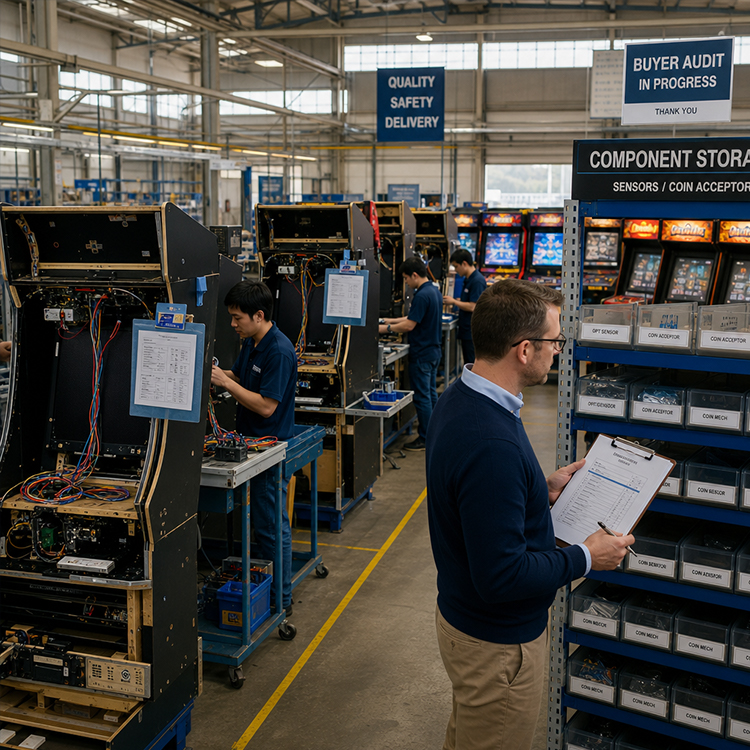
Most buyers who travel to China to inspect an arcade machine factory come back with photographs of a clean showroom, a pleasant lunch, and no more real information than they had before boarding the plane.
This is not their fault. A factory visit is a compressed, unfamiliar, translation-mediated encounter in which the host controls the route. Without a structured plan, the visit becomes a hospitality event rather than an audit.
It does not have to be. Four focused hours on a production floor, spent asking specific questions and looking at specific things, produces more decision-relevant information than six months of email exchange. The purpose of this guide is to make that time count.
Written from Sunflower Amusement’s perspective as a manufacturer in the Panyu (Guangzhou) amusement equipment cluster — a factory that hosts these visits regularly — this is the audit we would want a serious buyer to run, because a buyer who audits properly becomes a buyer who stays for eight years.
The Buyer’s Central Question
Perspectiva do comprador: A distributor from Bogotá lands in Guangzhou with three factory appointments in two days. His actual question is not “are these machines good?” — he can assess that from a showroom demo. His question is: “Which of these three can still supply me spare parts, honour a warranty, and produce consistent quality in 2034?”
That is a question about manufacturing capability and organisational durability, not about the machines on display.
Perspectiva do engenheiro de design da Sunflower: From inside a factory, we can tell within minutes whether a visiting buyer knows what to look for. The ones who do ask about assembly line staffing, testing protocols, and BOM control. The ones who do not ask about price and lead time — questions they could have asked by email.
The uncomfortable truth of this industry: in the Panyu cluster there are genuine manufacturers with in-house R&D, tooling and assembly, and there are trading companies with a showroom and a WeChat contact list who outsource everything. Both look identical in a catalog. They diverge completely the day you need a replacement PCB for a model discontinued three years ago.
Part 1 — Before You Travel: Pre-Visit Verification
Two hours of desk research before departure changes what you are able to see on the floor.
Documents to Request in Advance
| Document | What it tells you |
| Business licence (营业执照) | Registered company name, registered capital, establishment date, and — critically — the registered business scope, which states whether manufacturing is included |
| ISO 9001 certificate | Whether a documented quality system exists, and the certificate’s stated scope and site address |
| Factory address and land/lease documentation | Whether the “factory” address matches the business licence address |
| Export licence / customs registration | Whether the entity can export directly or must route through an agent |
| CE / test report samples | Whether reports are issued to this legal entity or to a third party |
| Recent production photos or video walkthrough | Baseline expectation to compare against reality |
The Three Pre-Visit Red Flags
1. Test reports issued to a different company name. This is the clearest single indicator that the machines are made elsewhere. Ask directly: “Why is this report issued to a different entity?” A legitimate answer exists (group structure, a renamed entity) but it must be given.
2. Business scope that omits manufacturing. A business licence limited to wholesale and trade is a trading company, regardless of how the website describes them.
3. Reluctance to give a specific factory address before the visit. Genuine manufacturers give an address. Intermediaries propose meeting “at the showroom” and arranging transport.
Practical note on the Panyu cluster: Guangzhou’s Panyu district is the global centre of amusement machine manufacturing, and genuine clustering means legitimate specialisation — a manufacturer may make cabinets and mechanics in-house while sourcing displays and coin acceptors from specialist suppliers. That is normal and healthy. What matters is whether core assembly, testing and quality control happen under their own roof and control.
Part 2 — The 4-Hour Floor Audit
Perspectiva do engenheiro de design da Sunflower: Here is how to allocate the time. Insist on this sequence — showroom last, not first. A host who resists starting on the production floor is telling you something.
Hour 1 — Raw Material and Component Store (the most revealing 60 minutes)
Component storage tells you more about quality philosophy than any finished machine.
What to look at:
- Board material stock. Is MDF stored flat, off the floor, in a dry area? Warped or damp-edged board becomes warped cabinets. Ask the thickness — 18mm indicates commercial intent, 12mm indicates cost-cutting.
- Steel stock and powder coating. Is there steel bracing stock, or only board? Is there an in-house powder coating line or is it outsourced?
- Electronic component storage. Are PCBs and components in anti-static packaging? Are power supplies from identifiable brands with visible safety marks, or unbranded?
- Named-brand critical components. Look for recognisable brands on capacitors, sensors, motors and coin acceptors. Ask which brands are used and ask to see them in stock.
- Traceability. Is there any incoming inspection record on component batches? Ask to see one.
Questions that produce real information:
- “What is the thickness of the MDF you use for cabinet panels, and can I see it in stock?”
- “Which brand of power supply goes into this model? Can I see one?”
- “What is your incoming inspection process for PCBs?”
Hour 2 — Assembly Line and Production Floor
What to look at:
- Actual headcount versus claimed headcount. Count people on the line. A factory claiming 200 staff with twelve people working is either seasonally idle (ask why) or misrepresenting scale.
- Work-in-progress inventory. Are there partially assembled machines at multiple stations? A genuine production line has WIP. An empty floor with only finished units suggests assembly happens elsewhere.
- Station organisation. Are there defined workstations with tooling, jigs and documented work instructions posted? Or is assembly improvised?
- In-house tooling and fixtures. Custom jigs indicate genuine manufacturing investment. Their absence suggests low-volume hand assembly or outsourcing.
- Wiring harness preparation. Is there a harness-making area with crimping tooling, or are harnesses bought in? Either is acceptable, but the answer tells you about vertical integration.
- Cabinet production. Is there a CNC or panel saw area, edge banding, and a spray or wrap line? If cabinets arrive finished from outside, the “factory” is an assembler.
Questions that expose the truth:
- “How many machines does this line produce per day at full capacity?”
- “Which parts of this machine are made in this building, and which are bought in?”
- “Can I watch a machine being assembled from cabinet to finished unit?”
Hour 3 — Quality Control and Testing (the decisive hour)
Perspectiva do engenheiro de design da Sunflower: This is where genuine manufacturers separate from assemblers, because real testing requires equipment, procedure and time — all of which cost money that a cost-cutting operation will not spend.
What to look at:
- Burn-in / run-in area. Is there a designated area where finished machines run continuously before shipment? Ask how many hours. Meaningful burn-in is measured in hours, not minutes. This single practice catches the majority of infant-mortality failures.
- Electrical safety test equipment. Look for a hipot (dielectric strength) tester, earth continuity tester and insulation resistance meter. Ask to see a test record. If this equipment does not exist, electrical safety claims are unsupported.
- Functional test protocol. Is there a written checklist per model? Ask to see a completed one for a machine currently ready to ship.
- Ticket dispenser and coin acceptor testing. These are the two highest-failure subsystems. Ask specifically how they are tested — a competent factory cycles them.
- Defect log and rework area. A factory with no visible defect log is not measuring quality. Ask: “What is your first-pass yield?” and “What are your top three defect causes this month?” These questions are difficult to answer with an improvised number.
- Final inspection before packing. Is there a sign-off step with a named inspector?
Questions worth the trip:
- “How many hours do you burn-in a finished machine before packing?”
- “Can I see the hipot test record for a machine you are shipping this week?”
- “What were your top three defect causes last month, and what did you change?”
Hour 4 — R&D, Spare Parts and Documentation
What to look at:
- R&D presence. Is there an engineering area with CAD workstations, prototype units, and engineers who can discuss design decisions? Ask to meet an engineer, not a salesperson.
- Prototype and tooling evidence. Are there past prototypes, moulds, or tooling stored on site? Genuine product development leaves physical residue.
- Spare parts warehouse. This is the single best predictor of long-term support. Ask: “Show me where you store spare parts for a model you stopped producing three years ago.” A factory that can walk you to that shelf will support you in 2034. One that cannot, will not.
- Documentation quality. Ask to see the service manual and wiring diagram for a machine on the floor. Is it in English? Is it complete? Does it have part numbers?
- BOM control. Ask whether the BOM for a given model is version-controlled, and how a component substitution is approved. Uncontrolled substitution is how quality silently degrades between orders.
The two questions that matter most for long-term partnership:
- “For how many years after production ends do you stock original spare parts?”
- “If your capacitor supplier discontinues a part, what is your process for approving a replacement?”
Showroom — Last, and Briefly
The showroom is a sales environment. Visit it, play the machines, confirm build feel and finish quality — but do it after you have seen how they are made, so you are evaluating evidence rather than presentation.
Part 3 — Distinguishing Manufacturer from Trading Company
Perspectiva do engenheiro de design da Sunflower: There is nothing inherently wrong with buying through a trading company — some are excellent, well-organised and add genuine value in coordination and export handling. The problem is buying from one while believing you are buying from a factory, because your assumptions about warranty, spare parts and quality control will be wrong.
Ten Signals of a Genuine Manufacturer
| # | Signal |
| 1 | Business licence business scope explicitly includes manufacturing |
| 2 | Test reports and ISO certificate issued to the same legal entity you are contracting with |
| 3 | Visible cabinet production: panel cutting, edge banding, finishing on site |
| 4 | Work-in-progress at multiple assembly stations, not just finished goods |
| 5 | Electrical safety test equipment present, with completed test records |
| 6 | Designated burn-in area with a stated duration policy |
| 7 | Engineers available who can discuss design trade-offs without consulting sales |
| 8 | Spare parts warehouse containing parts for discontinued models |
| 9 | Version-controlled BOM with a documented substitution approval process |
| 10 | Willingness to let you observe assembly of the specific model you are buying |
Six Signals of an Intermediary Presenting as a Factory
| # | Signal |
| 1 | Meeting proposed at a showroom or office rather than a production address |
| 2 | Documents issued to entity names that differ from the contracting party, without explanation |
| 3 | Production floor with only finished units and no WIP |
| 4 | No test equipment, or test equipment that is visibly unused |
| 5 | Technical questions consistently redirected to “our engineer will confirm later” |
| 6 | Cannot show spare parts stock for older models |
Part 4 — Questions That Cannot Be Answered With a Script
Perspectiva do engenheiro de design da Sunflower: Sales teams are prepared for standard questions. These are the ones that require genuine operational knowledge, which means the answer itself tells you who you are talking to.
1. “What is the MDF thickness and is it fire-retardant treated? Can you show me the material certificate?”
Tests both material quality and documentation discipline.
2. “Which specific brand and series of electrolytic capacitors are on the main board?”
A real engineer names the brand and series. A trading company says “high quality Japanese capacitors.”
3. “How many hours is your burn-in, and what percentage of machines fail during it?”
A factory that measures this has a number. One that does not, does not test.
4. “What was your first-pass yield last month?”
Requires an actual quality system to answer.
5. “Show me the spare parts shelf for a model you discontinued three years ago.”
The best single predictor of long-term support.
6. “If I order this model again in eighteen months, what will be different about it?”
A well-run factory knows its own change pipeline. “Nothing will change” is usually untrue.
7. “Who signs off the final inspection, and what happens if a machine fails it?”
Tests whether QC has authority or is decorative.
8. “Can I speak to one of your engineers about how this mechanism was designed?”
Direct engineering access is a structural indicator.
9. “What is your current production queue length before a new order starts?”
Honest capacity disclosure is a trust signal in itself.
10. “Which of your customers has been buying from you longest, and can I speak to them?”
Long-tenure customers are the strongest possible reference.
Part 5 — What to Do After the Visit
A visit only creates value if it converts into structured comparison and contractual terms.
Same-Day Documentation
Write it down before dinner. Specifically capture:
- Photographs of the production floor, component store, test area and spare parts warehouse
- Headcount observed on the line
- Burn-in duration stated
- Named component brands
- Spare parts availability commitment in years
- Names and roles of people met, especially engineers
Convert Findings Into Contract Terms
| What you verified | What to write into the PO or agreement |
| Stated burn-in duration | “All units to receive minimum X hours burn-in prior to packing” |
| Named component brands | Specify brand/series for power supply, capacitors, motors, sensors in the PO |
| Spare parts commitment | “Original spare parts availability guaranteed for X years post-production” |
| BOM change control | “Supplier to notify buyer in writing of any change to specified components” |
| Test records | “Hipot and functional test records to be supplied with shipping documents” |
| Documentation | “English service manual, wiring diagram and parts list with part numbers to ship with each unit” |
Perspectiva do engenheiro de design da Sunflower: This step is what separates a productive visit from a pleasant one. Verbal commitments made on a factory floor are genuine but not enforceable. Writing them into the purchase order costs nothing and changes the relationship from trust-based to specification-based — which protects both sides.
If You Cannot Travel
Not every buyer can fly to Guangzhou, particularly for a first order. Reasonable substitutes, in descending order of reliability:
1. Third-party factory audit — SGS, Bureau Veritas, Intertek and TUV all offer supplier audits at roughly USD 800–2,500, covering many of the same points with a written report
2. Live video walkthrough — request an unscripted, real-time video call from the production floor rather than an edited video. Ask the host to walk to the spare parts warehouse on camera.
3. Existing customer references in your region — ask for two distributors in comparable markets and contact them directly
4. Pre-shipment inspection on the first order — does not audit capability, but verifies the specific shipment
Sunflower Amusement’s Position on Factory Visits
Sunflower Amusement is a manufacturer in the Panyu amusement equipment cluster, and we treat buyer audits as a normal part of doing business:
- Open production floor access — buyers are welcome to observe assembly of the specific models they are purchasing
- Component store transparency — we disclose and show named-brand critical components, including power supplies, capacitors, sensors and motors
- Test equipment and records — hipot, earth continuity and functional test records available for inspection
- Documented burn-in policy on finished units before packing
- Spare parts warehouse stocking original parts for models discontinued years earlier — we will walk you to the shelf
- Direct engineer access — technical questions answered by engineers, not relayed through sales
- Version-controlled BOM with a documented component substitution approval process
- Third-party audit cooperation — we host SGS, Bureau Veritas, Intertek and TUV audits on buyer request
- Live unscripted video walkthrough for buyers who cannot travel
- Customer references in MENA, LATAM, EU and North American markets, available on request
Planning a factory visit or a remote audit? Contact us to schedule a production floor visit or an unscripted live video walkthrough, ou browse the catalog to define which models you want to see in production.
Perguntas frequentes
Q: How can I tell if a Chinese arcade supplier is a real factory or a trading company?
A: Check three things. First, the business licence business scope — it must explicitly include manufacturing. Second, whether test reports and ISO certificates are issued to the same legal entity you are contracting with. Third, on site: is there work-in-progress at multiple assembly stations, cabinet production, and test equipment with completed records? Finished goods alone in a warehouse indicates assembly or trading, not manufacturing.
Q: What should I look at first during a factory visit?
A: The raw material and component store, then the assembly line, then quality control and testing, then R&D and spare parts. Visit the showroom last. A host who insists on starting in the showroom is managing your impression rather than showing you their capability.
Q: What is the single most useful question to ask an arcade machine factory?
A: “Show me where you store spare parts for a model you stopped producing three years ago.” Parts availability for discontinued models is the strongest predictor of whether a supplier will support you over an eight-year ownership period, and it cannot be faked on the spot.
Q: How long should a factory visit be?
A: Four focused hours on the production floor is sufficient to reach a confident judgement, provided you follow a structured sequence. Two full days across three factories is a realistic and productive trip.
Q: Is buying through a trading company always a bad idea?
A: No. Some trading companies are well-organised and add real value in coordination, consolidation and export handling. The risk is not the intermediary itself — it is buying from one while believing you are buying from a factory, which leaves your assumptions about warranty, spare parts and quality control unfounded.
Q: What if I cannot travel to China?
A: Commission a third-party supplier audit from SGS, Bureau Veritas, Intertek or TUV (roughly USD 800–2,500 with a written report), request an unscripted live video walkthrough rather than an edited video, contact two existing customers in comparable markets, and schedule pre-shipment inspection on your first order.
Q: Why does Panyu in Guangzhou matter for arcade machines?
A: Panyu district is the principal global manufacturing cluster for amusement machines, which means dense specialisation, mature component supply chains and a concentration of both genuine manufacturers and intermediaries. Clustering is an advantage for buyers — multiple factories can be visited in one trip — but it also means visual similarity between very different types of supplier.
Q: Should I put factory visit findings into my purchase order?
A: Yes, and this is the step most buyers skip. Convert verbal commitments — burn-in duration, named component brands, spare parts availability years, BOM change notification, test records with shipping documents — into written PO terms. It costs nothing and shifts the relationship from trust-based to specification-based.