

The most expensive place to discover a certification problem is at the destination port, with a container of forty arcade machines accruing demurrage at USD 120–280 per day while a customs broker explains that the paperwork does not satisfy the local conformity regime.
This happens more often than the industry admits, and it almost never happens because the machines are unsafe. It happens because certification is treated as a document the factory emails over at the end, rather than a technical process with lead times, test costs, and a clear division of responsibility between manufacturer and importer.
This guide explains what each major certification regime actually requires for amusement equipment, who is legally responsible for what, what it costs, how long it takes, and — critically — the specific questions a buyer must resolve with their supplier before a deposit is wired. It is written from Sunflower Amusement’s engineering perspective, based on how compliance files are actually constructed and where they most often fail.
The Buyer’s Port-Side Discovery
Buyer perspective: An importer in Jeddah orders thirty-two machines. The supplier confirms “we have CE certificate, no problem.” The container arrives. Saudi customs requires a SABER Certificate of Conformity linked to a Product Certificate for the specific product category — CE is irrelevant to the Saudi regime. There is no SABER registration. The goods sit in bonded storage for nineteen days while the importer arranges conformity assessment retroactively, at roughly triple the cost of doing it pre-shipment, plus USD 4,300 in storage and demurrage.
Sunflower design engineer perspective: The failure here is not fraud. The supplier genuinely had a CE test report. The failure is that neither party mapped the destination market’s specific regime before shipping. CE, UL, SASO/SABER, INMETRO and NOM are not interchangeable, not mutually recognised, and not substitutable. A buyer who asks “do you have certification?” gets a useless answer. A buyer who asks “can you supply a SABER-linked Product Certificate for HS code X into Saudi Arabia, and who is the importer of record on that certificate?” gets an actionable one.
Part 1 — What Certification Actually Tests
Before comparing regimes, it helps to understand that nearly all of them test the same underlying properties, using different standards and administrative wrappers.
The Four Test Domains for Amusement Equipment
1. Electrical safety
Insulation resistance, dielectric strength (hipot), earth continuity, leakage current, protection against electric shock, temperature rise under load, abnormal operation behaviour, fire enclosure integrity. The governing standard family internationally is IEC 60335-1 (household and similar electrical appliances, general requirements), with IEC 62368-1 increasingly applied to audio/video and information equipment inside machines.
2. Electromagnetic compatibility (EMC)
Two directions. Emissions: does the machine radiate interference that could disrupt other equipment (CISPR 32 / EN 55032). Immunity: does the machine keep working when subjected to external interference, electrostatic discharge, voltage dips and surges (EN 55035, IEC 61000 series). Arcade machines with motors, switching power supplies and LED drivers are meaningful emitters, so EMC is not a formality.
3. Mechanical safety
Pinch points, shear points, sharp edges, stability against tipping, guarding of moving parts, accessible-part temperature limits, structural integrity. For machines aimed at children, additional scrutiny on reachable gaps and small parts.
4. Material and substance compliance
RoHS (restriction of hazardous substances — lead, mercury, cadmium, hexavalent chromium, and specified flame retardants), and in the EU also REACH obligations. For machines with child users, some markets apply toy-adjacent chemical requirements to accessible surfaces.
Sunflower design engineer perspective: These four domains are where the actual engineering work sits. A machine that genuinely passes IEC 60335-1 and EN 55032 has been designed to pass — correct creepage and clearance distances on the PCB, a properly bonded metal chassis, a compliant power supply with real safety approvals, filtered motor drives, and fused branch circuits. A machine that “has a certificate” but was not designed to these principles usually reveals itself during any competent retest.
Part 2 — The Major Regimes, Market by Market
CE Marking — European Union, UK (UKCA), and widely referenced elsewhere
What it is: CE is a self-declaration regime. There is no central authority that issues a “CE certificate.” The manufacturer or the EU importer declares conformity with applicable directives and affixes the mark.
Applicable directives for arcade machines:
- Low Voltage Directive 2014/35/EU
- EMC Directive 2014/30/EU
- RoHS Directive 2011/65/EU
- Machinery Directive 2006/42/EC where mechanical hazards apply
- Radio Equipment Directive 2014/53/EU if the machine contains wireless modules (Wi-Fi, Bluetooth, 4G for IoT)
What the file must contain:
- Test reports from a competent laboratory against the harmonised standards
- Technical Construction File (schematics, BOM with safety-critical component approvals, risk assessment, user manual)
- Declaration of Conformity (DoC) signed by a named legal person
- Details of the EU Authorised Representative or importer taking responsibility
Critical nuance most buyers miss: Because CE is self-declared, a “CE certificate” from a Chinese test lab is a test report, not a certification. It is a necessary input, not the deliverable. The legally operative document is the DoC, and under current EU market surveillance rules the EU-based importer carries substantial responsibility for its accuracy.
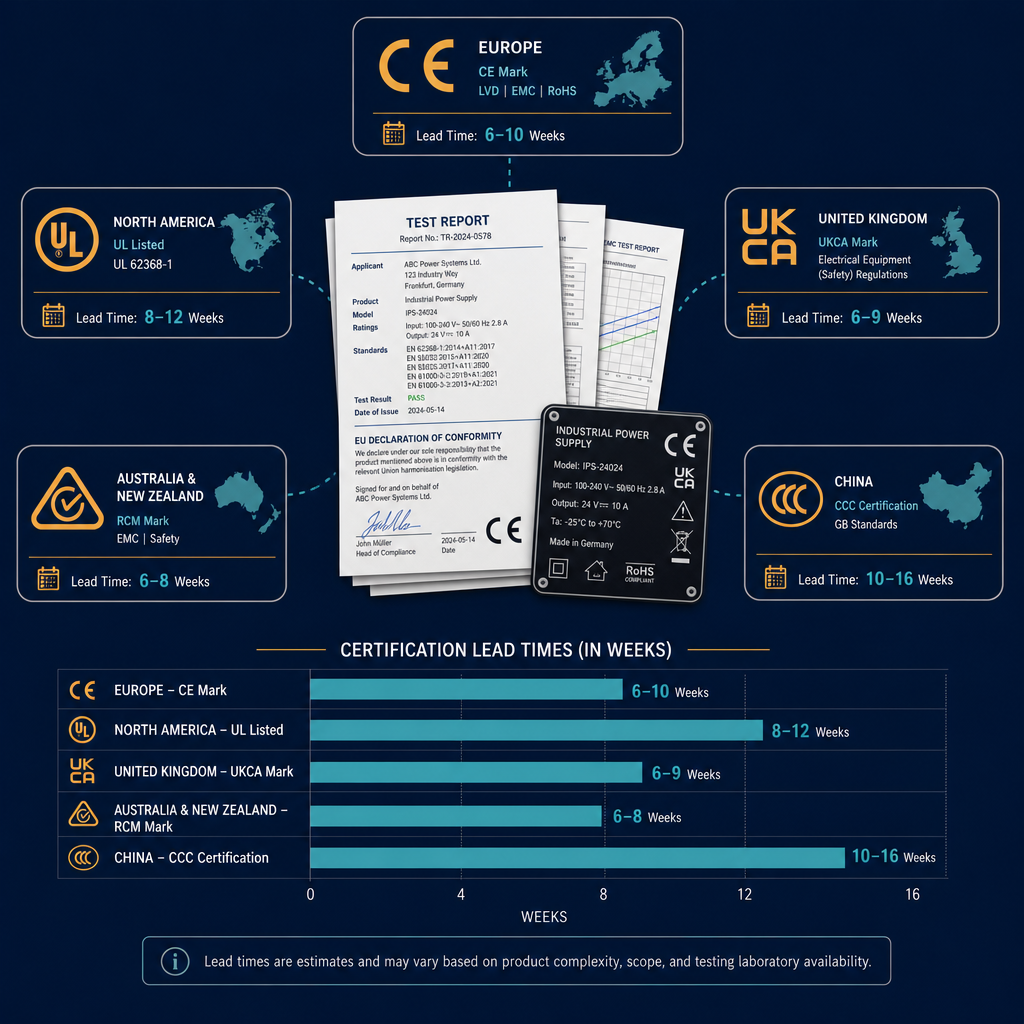
Indicative cost: USD 1,800–6,500 per machine platform for full LVD + EMC + RoHS testing. Machines sharing a common electrical architecture can often be grouped into a single test family, dramatically reducing per-model cost.
Indicative timeline: 3–6 weeks for testing and report issuance.
UK note: Post-Brexit, Great Britain uses UKCA marking with largely equivalent technical requirements but a separate declaration and a UK-based responsible person. Northern Ireland follows CE.
UL / ETL Listing — United States and Canada
What it is: Unlike CE, this is third-party certification. A Nationally Recognized Testing Laboratory (NRTL) — UL, Intertek (ETL), CSA, TUV — tests the product and issues a listing. The mark cannot be self-applied.
Applicable standards: UL 22 has historically covered amusement and gaming machines; UL 62368-1 applies to much of the electronics inside. Canadian equivalents are the CSA C22.2 series.
Why it matters commercially: Federal law does not universally mandate NRTL listing for arcade machines, but three parties effectively do:
1. Insurance carriers — many commercial general liability policies for entertainment venues require listed equipment, or price unlisted equipment punitively
2. Landlords and mall operators — fit-out approval frequently requires listed electrical equipment
3. Local electrical inspectors — under the National Electrical Code, an inspector can require evidence of listing for permanently connected equipment
Indicative cost: USD 4,500–18,000 per machine platform, plus ongoing factory surveillance/follow-up service fees (typically USD 800–2,500 annually). This is materially more expensive than CE because it involves third-party certification plus periodic factory inspection.
Indicative timeline: 8–20 weeks, longer if design modifications are required during testing.
Sunflower design engineer perspective: This cost structure explains a real market pattern. Many Chinese manufacturers hold CE test reports but not UL listings, because UL requires sustained factory surveillance and per-platform investment. Buyers importing into the US should confirm listing status per specific model, not per factory, and should ask to see the listing entry in the certifier’s public online directory rather than accepting a PDF.
SASO / SABER — Saudi Arabia
What it is: A two-stage electronic conformity platform. Saudi Arabia requires products in regulated categories to obtain a Product Certificate of Conformity (PC) through an approved Conformity Assessment Body, then a Shipment Certificate of Conformity (SC) for each consignment, both processed through the SABER platform.
Process:
1. Importer registers the product on SABER under the correct HS code
2. Selects an approved Conformity Assessment Body
3. Submits technical file — test reports (IEC-based reports are generally accepted as input), photos, labelling, Arabic marking details
4. Product Certificate issued, typically valid one year
5. For each shipment, a Shipment Certificate is issued referencing the PC
Critical points:
- The importer of record is the applicant. The Chinese factory cannot hold the Saudi PC on the importer’s behalf — the certificate is tied to the Saudi importer’s commercial registration. This is the single most common misunderstanding.
- Arabic labelling requirements apply to product marking and user documentation
- Energy efficiency and specific technical regulations may apply depending on category classification
- Palletisation and packing requirements have tightened; confirm current requirements with your freight forwarder
Indicative cost: USD 400–1,600 for the Product Certificate depending on category and CAB, plus USD 100–350 per Shipment Certificate.
Indicative timeline: 1–3 weeks for the PC when the technical file is complete; 1–3 days for each SC.
ECAS / EQM — United Arab Emirates
What it is: The Emirates Conformity Assessment Scheme, administered by the Emirates Authority for Standardization and Metrology (ESMA/MoIAT). Electrical products in scope require an ECAS Certificate of Conformity.
Process: Similar in structure to SABER — importer applies, submits IEC-based test reports and technical documentation, receives a certificate typically valid one year.
Indicative cost: USD 500–2,000 per product family.
Indicative timeline: 2–4 weeks.
Practical note: Dubai’s clearance process is comparatively efficient — often 12–24 hours for correctly documented shipments — which makes UAE a common regional distribution hub for onward movement into GCC markets. Buyers should confirm whether onward re-export requires the destination country’s own certification (it usually does).
INMETRO — Brazil
What it is: Brazil’s National Institute of Metrology, Quality and Technology operates a compulsory certification regime for listed product categories, administered through accredited certification bodies (OCPs).
Key characteristics:
- Testing must generally be performed or witnessed by Brazil-accredited laboratories. Foreign test reports are frequently not accepted as a substitute, which is the single biggest cost and timeline driver.
- Factory audit is typically required for the applicable certification model
- Periodic maintenance audits and retesting to keep certification valid
- Portuguese labelling and documentation required
- Certification holder is normally the Brazilian importer or a local legal entity
Indicative cost: USD 6,000–22,000 per product family including testing, audit and certification, plus annual maintenance costs.
Indicative timeline: 12–28 weeks. This is the longest of the major regimes.
Sunflower design engineer perspective: Brazil is the market where buyers most frequently underestimate compliance. An importer planning a Q2 opening in São Paulo who begins INMETRO work in Q1 will not make it. INMETRO planning needs to start roughly six to nine months before target arrival, and it is usually most efficient to certify a platform family once and then import multiple models against it, rather than certifying model by model.
NOM — Mexico
What it is: Normas Oficiales Mexicanas — mandatory Mexican standards. For electrical equipment, NOM-001-SCFI (electrical safety of electronic apparatus) commonly applies, with certification issued by accredited bodies such as ANCE or NYCE.
Key characteristics:
- Testing generally required at a Mexican accredited laboratory, or via a recognised report acceptance route where available
- Spanish labelling per NOM-024-SCFI (commercial information, instructions, warranties)
- Certificate held by the Mexican importer
- Certification typically valid one year with renewal requirements
Indicative cost: USD 2,500–9,000 per product family.
Indicative timeline: 6–14 weeks.
Comparison Summary
| Regime | Market | Type | Who holds it | Indicative cost per family | Timeline |
| CE | EU | Self-declaration | Manufacturer / EU importer | USD 1,800–6,500 | 3–6 weeks |
| UKCA | Great Britain | Self-declaration | Manufacturer / UK responsible person | USD 1,800–6,000 | 3–6 weeks |
| UL / ETL | US, Canada | Third-party certification | Manufacturer (listed) | USD 4,500–18,000 + annual | 8–20 weeks |
| SASO / SABER | Saudi Arabia | Platform certification | Saudi importer | USD 400–1,600 + per-shipment | 1–3 weeks |
| ECAS | UAE | Certification | UAE importer | USD 500–2,000 | 2–4 weeks |
| INMETRO | Brazil | Compulsory certification | Brazilian importer / local entity | USD 6,000–22,000 + annual | 12–28 weeks |
| NOM | Mexico | Compulsory certification | Mexican importer | USD 2,500–9,000 | 6–14 weeks |
The pattern worth noticing: In four of the seven regimes, the certificate is held by the importer, not the factory. This is why “does your factory have certification?” is the wrong question in MENA and LATAM markets. The right question is “can you supply the test reports and technical file I need to obtain my own certificate?”
Part 3 — Division of Responsibility
Sunflower design engineer perspective: Compliance disputes almost always trace back to an unstated assumption about who does what. Here is how it should be allocated.
The Manufacturer’s Responsibilities
1. Design the machine to the relevant technical standards (not retrofit compliance afterward)
2. Use safety-critical components with their own valid approvals — power supplies, transformers, wiring, fuses
3. Maintain a Technical Construction File per platform: schematics, BOM with component approvals, risk assessment
4. Commission and hold test reports from competent laboratories
5. Provide user manuals, wiring diagrams and safety instructions in the required language
6. Apply correct product marking, rating plates and warning labels
7. Support the importer’s certification application with documentation, photos, and samples for testing
8. Notify the buyer if a design change affects the validity of existing test reports
The Importer’s Responsibilities
1. Determine which regime applies in the destination market — before ordering
2. Hold and maintain the local certificate where the regime requires importer ownership (SABER, ECAS, INMETRO, NOM)
3. Appoint an EU/UK Authorised Representative where required
4. Arrange local-language labelling compliance
5. Fund local testing where the regime mandates it (notably Brazil and Mexico)
6. Retain the compliance file for the statutory retention period
7. Ensure the declared HS classification matches the certified product scope
The Shared Grey Zones
| Issue | Who typically handles it | Resolve by |
| Local-language labelling | Factory can print; importer defines content | Specify label artwork in the PO |
| Test samples for local labs | Factory supplies; importer pays freight and test fees | Agree in writing before deposit |
| Retest after design change | Factory notifies; importer funds recertification | Contract clause requiring change notification |
| Wireless module approval (IoT models) | Factory supplies module approvals; importer verifies local radio rules | Confirm module certification numbers early |
Part 4 — What Buyers Should Request Before Wiring a Deposit
Sunflower design engineer perspective: This is the checklist that prevents port-side surprises. All of it should be resolved before the deposit, not after production.
1. Test reports as PDFs with report numbers — not a photo of a certificate. Verify the report number with the issuing laboratory where possible.
2. Confirmation of which models the reports cover — test reports cover specific platforms. Ask explicitly whether the models on your PO are within scope.
3. Component safety approvals for the power supply and transformer — these are the highest-risk components and the easiest place to cut cost invisibly.
4. A stated position on your destination regime — “we can supply IEC-based test reports and technical file to support your SABER Product Certificate application” is a good answer. “We have international certificate” is not.
5. Sample availability for local testing — required for Brazil and Mexico. Confirm the factory will supply, and who pays freight.
6. Labelling artwork approval — rating plate, warnings, language, importer details.
7. Change notification clause — written commitment that the factory will inform you if a design change invalidates existing reports.
8. Wireless module certification numbers if ordering IoT-connected models.
Part 5 — Cost and Timeline Planning by Market
A worked planning example for a buyer importing the same 6-model machine mix into three markets.
| Market | Regime | Who pays what | Total compliance cost | Add to lead time |
| Germany | CE | Factory holds test reports; importer signs DoC, appoints AR | USD 0–800 (reports already held) | 0 weeks |
| Saudi Arabia | SABER | Importer applies using factory reports | USD 900–2,400 + SC per shipment | 2–3 weeks |
| Brazil | INMETRO | Importer funds local testing and audit | USD 9,000–22,000 | 14–28 weeks |
The strategic implication: Compliance cost per unit falls sharply with order size. On a 40-machine order into Brazil, USD 15,000 of INMETRO cost is USD 375 per machine. On a 6-machine order it is USD 2,500 per machine — often enough to make the order uneconomic. Buyers entering high-compliance-cost markets should plan larger consolidated orders, or certify a platform family once and import repeatedly against it.
Sunflower Amusement’s Compliance Support
Sunflower Amusement designs to international standards and maintains compliance documentation as a standing capability rather than an ad-hoc request:
- CE test reports (LVD, EMC, RoHS) maintained per machine platform, with report numbers verifiable at the issuing laboratory
- ISO 9001 quality management certification
- Technical Construction File per platform — schematics, BOM with safety-critical component approvals, risk assessment
- Safety-approved power supplies and transformers with their own component certifications, disclosed in the BOM
- Documentation support for importer-held regimes — we supply the technical file, photos, and product data needed for SABER, ECAS, NOM and INMETRO applications
- Test samples supplied for Brazil and Mexico local laboratory testing
- Labelling artwork produced to importer specification, including Arabic, Spanish and Portuguese
- Design change notification — we inform buyers when a change affects existing report validity
- English-language manuals and wiring diagrams shipped with every machine
Planning an import into a regulated market? Tell us your destination market and machine mix and we will confirm exactly which documentation we can supply for your certification route, or browse the catalog to define your model list first.
FAQ
Q: Do arcade machines need CE certification?
A: For the EU market, arcade machines must comply with the Low Voltage, EMC and RoHS Directives, and the Machinery Directive where mechanical hazards apply. CE is a self-declaration regime — there is no issued “CE certificate.” The operative document is a signed Declaration of Conformity supported by test reports and a Technical Construction File.
Q: Is a CE certificate from a Chinese lab valid?
A: A test report from a competent Chinese laboratory is a legitimate and necessary input to the compliance file. What is not valid is treating that report as the certification itself. The Declaration of Conformity must still be issued, and the EU importer carries responsibility for its accuracy under market surveillance rules.
Q: Do I need UL listing to sell arcade machines in the US?
A: Federal law does not universally mandate it, but insurers, landlords and local electrical inspectors frequently do in practice. Unlisted equipment often results in higher liability premiums or refused fit-out approval. Confirm listing per specific model and verify it in the certifier’s public directory.
Q: Can my Chinese factory hold my SASO certificate?
A: No. The Saudi Product Certificate on the SABER platform is tied to the importer’s commercial registration. The factory supplies test reports and technical documentation; the importer applies for and holds the certificate. The same applies to ECAS in UAE, NOM in Mexico and INMETRO in Brazil.
Q: Why is INMETRO certification so expensive?
A: Brazil generally requires testing at Brazil-accredited laboratories rather than accepting foreign reports, plus a factory audit and periodic maintenance audits. This drives cost to USD 6,000–22,000 per product family and timelines of 12–28 weeks. Plan INMETRO six to nine months before target arrival.
Q: How long does arcade machine certification take?
A: CE and UKCA testing: 3–6 weeks. SABER Product Certificate: 1–3 weeks with a complete file. ECAS: 2–4 weeks. NOM: 6–14 weeks. UL listing: 8–20 weeks. INMETRO: 12–28 weeks.
Q: Can one certificate cover multiple machine models?
A: Often yes, if the models share a common electrical architecture and can be grouped as a test family. This is the single biggest lever for reducing per-model compliance cost. Ask your supplier explicitly which of your selected models fall within one test family.
Q: What happens if my container arrives without correct certification?
A: Typically the goods are held in bonded storage pending retroactive conformity assessment, which costs substantially more than pre-shipment certification and accrues demurrage and storage at USD 120–280 per day. In some cases goods can be refused entry entirely. Resolve certification before shipment, without exception.