


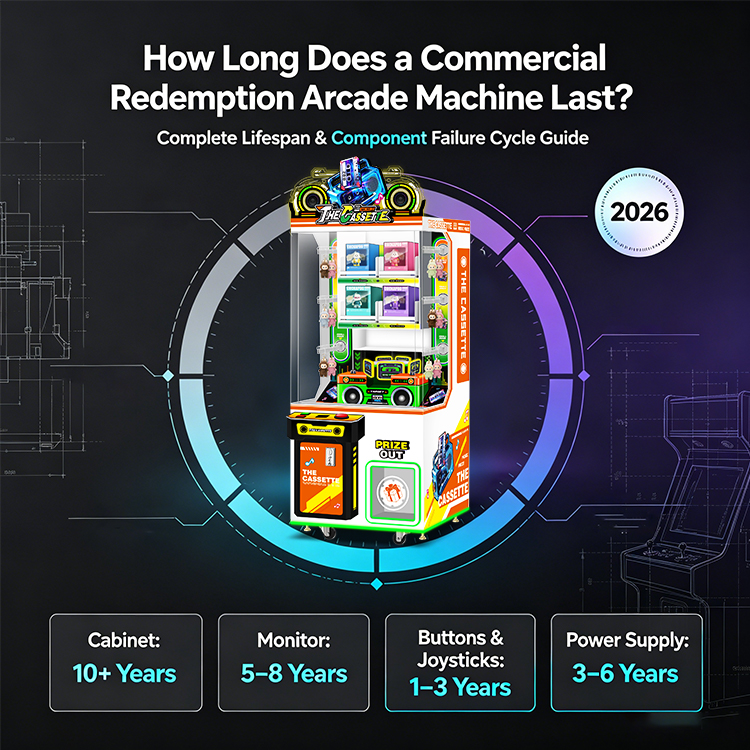
The single question every serious arcade equipment buyer asks before signing a purchase order: “How many years will this machine actually run?”
The honest answer, from 16 years of Sunflower Amusement factory experience shipping to distributors and FEC operators globally, is that the number varies enormously — from 3 years for a cost-cut cabinet in a high-traffic venue to 12+ years for a commercial-grade machine in a well-maintained environment. The variable is not the “brand name” on the cabinet; it’s the specific component decisions inside and the maintenance discipline of the operator.
This guide gives you what most manufacturer websites won’t: real component-level lifespan data, the specific failure cycles you should plan for, and the design and operator decisions that push a machine from 5-year life to 10-year life. It’s written for investors, procurement managers, and distributors who need to build accurate 5- to 10-year total cost of ownership models before committing to a purchase.
The Buyer’s Real Question — and Why the Answer Is Complicated
Perspectiva do comprador: A new FEC investor walks into a supplier meeting and asks: “How long will this commercial redemption arcade machine last?” A cost-cut salesperson answers: “10 years, no problem.” A serious engineering-led manufacturer answers: “The cabinet will last 12+ years. The main motor will need replacement around year 5–7. The ticket dispenser will need service every 18–24 months. The coin acceptor firmware will need updating when your country issues new coins. Here’s the full lifecycle schedule.”
The second answer is the truthful one. And it’s the answer that lets a buyer actually plan their business.
Sunflower design engineer perspective: In our post-sale field data (drawn from distributor service reports across MENA, LATAM, EU, and North America since 2010), we track failure cycles for every major subsystem. What we’ve learned is that “arcade machine lifespan” is not a single number — it’s a distribution across 36+ critical components, each with its own wear curve.
The Three Machine Lifespan Tiers
Not every commercial redemption arcade machine lives the same operational lifespan. There are three clearly distinguishable tiers, driven primarily by component quality and manufacturing discipline:
Tier 1 — Cost-Cut / “Grey Market” Machines
Typical operational lifespan:
- 3–5 years before major refurbishment required
Common failure profile:
- PSU failure (year 2), main PCB capacitor degradation (year 3), motor bearing failure (year 3–4), cabinet corner joint failure (year 4)
Total 5-year cost of ownership:
- 1.6–2.2x the initial purchase price (due to frequent repairs and downtime)
Resale value at year 5:
- Effectively zero — often cheaper to scrap than to refurbish
Tier 2 — Standard Commercial Machines
Typical operational lifespan:
- 6–8 years with routine maintenance
Common failure profile:
- First ticket dispenser service at year 2, main motor replacement at year 4–5, coin acceptor firmware update or replacement at year 3–4
Total 5-year cost of ownership:
- 1.15–1.25x initial purchase price
Resale value at year 5:
- 25–40% of original purchase price
Tier 3 — Premium Commercial / Engineering-Led Machines (Sunflower Standard)
Typical operational lifespan:
- 8–12 years with proper preventive maintenance
Common failure profile:
- Consumable replacements on schedule (ticket dispenser at year 3, LED strips at year 5–6), main mechanical components typically outlast the machine’s commercial relevance
Total 5-year cost of ownership:
- 1.06–1.12x initial purchase price
Resale value at year 5:
- 40–55% of original purchase price
The difference between Tier 1 and Tier 3 is not marketing — it’s specific component-level engineering decisions documented in the machine’s BOM.
The Complete Component Lifespan Table (Sunflower Field Data)
Sunflower design engineer perspective: Below is the actual field-observed lifespan data from our post-sale service tracking. These numbers reflect commercial operation at 8–14 hours daily in a well-ventilated FEC environment. Harsh environments (high humidity, high dust, direct sunlight, extreme temperatures) reduce these numbers by 15–30%.
Structural & Cabinet Components
| Component | Expected Life (Commercial) | First Service Point | Replacement Cost |
| Cabinet (18mm MDF, steel-braced) | 10–15 years | Year 8: corner joint check | USD 200–450 |
| Acrylic playfield window (UV-stable) | 6 a 8 anos | Year 6: clarity inspection | USD 45–120 |
| Steel service door hinges | 8–12 years | Year 6: lubrication only | USD 15–30 |
| T-handle cam lock | 5–8 years | Year 4: re-key or replace | USD 12–28 |
| Powder-coated exterior finish | 8–10 years | Year 7: touch-up recommended | USD 40–80 (touch-up kit) |
| Cabinet vinyl artwork wrap | 4–7 years | Year 5: fade inspection | USD 60–180 |
Mechanical & Motor Components
| Component | Expected Life (Commercial) | First Service Point | Replacement Cost |
| Main gameplay motor (brushless DC, MTBF 50k hr) | 5–8 years | Year 4: bearing lubrication | USD 35–90 |
| Auxiliary motors (lighting, effects) | 6–9 years | Year 5: inspection | USD 18–45 |
| Servo motor (position control) | 4–6 years | Year 3: calibration check | USD 45–120 |
| Drive belts and timing belts | 2 a 3 anos | Year 2: replacement | USD 8–20 |
| Bearings (main mechanical assemblies) | 5–7 years | Year 4: lubrication + inspection | USD 4–15 per bearing |
| Gears (nylon/composite) | 3–5 years | Year 3: wear inspection | USD 15–45 |
| Ticket dispenser mechanism | 2–4 years (500k+ cycle rated) | Year 2: full service | USD 65–130 |
Sensor & Detection Components
| Component | Expected Life (Commercial) | First Service Point | Replacement Cost |
| Photoelectric sensors (OMRON/Panasonic) | 5–7 years | Year 4: cleaning + alignment | USD 8–20 each |
| Micro-switches (OMRON D2F) | 4–6 years | Year 3: contact inspection | USD 3–8 each |
| Reed switches | 8–10 years | Year 7: rarely needs service | USD 2–5 each |
| Hall effect sensors | 6 a 8 anos | Year 5: check reading | USD 4–12 each |
| Optical encoders | 4–6 years | Year 3: cleaning | USD 25–65 |
Electronics & PCB Components
| Component | Expected Life (Commercial) | First Service Point | Replacement Cost |
| Main game PCB (with Japanese capacitors) | 8–12 years | Year 6: capacitor health check | USD 180–450 |
| I/O interface board | 7–10 years | Year 6: inspection | USD 80–180 |
| Power supply unit (commercial 80+ rated) | 5–8 years | Year 4: dust cleaning | USD 45–120 |
| Electrolytic capacitors (main PCB) | 6–10 years | Year 5: ESR check | USD 8–18 (full replacement set) |
| LED driver boards | 5–7 years | Year 4: inspection | USD 20–55 |
| Fuses | Consumable | As needed | USD 0.50–2 each |
| Wire harness | 8–12 years | Year 6: connector inspection | USD 40–120 |
Payment & Interface Components
| Component | Expected Life (Commercial) | First Service Point | Replacement Cost |
| Coin acceptor (CH-926 or equivalent) | 4–6 years | Year 3: firmware/calibration | USD 25–55 |
| Bill validator (ICT/ITL/JCM) | 4–7 years | Year 3: firmware update | USD 180–380 |
| Cashless RFID reader | 5–8 years | Year 4: firmware update | USD 60–150 |
| Coin hopper (payout mechanism) | 5–7 years | Year 4: cleaning + inspection | USD 80–180 |
| Button switches (illuminated) | 3–5 years | Year 3: replacement | USD 6–15 each |
Audio-Visual Components
| Component | Expected Life (Commercial) | First Service Point | Replacement Cost |
| LCD display (commercial-rated) | 5–8 years | Year 5: brightness check | USD 1000–3200 |
| LED cabinet strips (5050 SMD) | 5–7 years | Year 4: dead LED check | USD 30–80 (per strip) |
| Speakers (8-inch full-range) | 6–9 years | Year 5: distortion check | USD 250–600 each |
| Audio amplifier | 6–10 years | Year 5: heat check | USD 350–900 |
| Marquee light (fluorescent → LED conversion) | 4–8 years | Year 4: replacement | USD 200–650 |
Total consumable/wear parts inventory recommended for a 3-year operational stock:
- Ticket dispenser (1 spare per machine): USD 65–130
- Motor replacement kit (1 spare per 3 machines): USD 35–90
- Bearing/gear rebuild kit (1 per 5 machines): USD 40–80
- LED strip replacement set (1 per machine): USD 30–80
- Fuse and small electronics kit (per venue): USD 30–75
Factors That Extend or Shorten Machine Life
Sunflower design engineer perspective: The single largest variable in observed commercial redemption arcade machine lifespan is not the machine itself — it’s the operating environment and maintenance discipline. Two identical machines placed in different venues can differ in lifespan by 40–60%.
Factors That Extend Life (+15% to +40% lifespan)
Climate-controlled venue (18–24°C, RH 40–60%)
1. — Reduces thermal cycling stress on electronics; extends capacitor and motor life by 20–35%.
Weekly cleaning and dust removal
2. — Dust accumulation on PCBs and motor cooling vents is the #1 preventable cause of premature electronics failure.
Quarterly preventive maintenance schedule
3. — Lubrication of moving parts, sensor cleaning, and connector inspection extend mechanical life by 25–40%.
Original spare parts (not aftermarket)
4. — Aftermarket components typically match on form but not on precision specifications, accelerating wear on paired components.
Firmware updates
5. — Modern machines with cashless integration receive periodic firmware updates that improve reliability and add features.
Surge protection at venue power feed
6. — Prevents PSU and PCB damage from grid voltage spikes.
Factors That Shorten Life (-15% to -50% lifespan)
High-humidity coastal or tropical environments without air conditioning
1. — Accelerates corrosion on PCB solder joints and connector contacts.
Direct sunlight exposure through venue windows
2. — UV damage to acrylic, artwork, and LCD panels; typically 40–60% faster degradation.
Dust-heavy environments (near construction, unpaved areas)
3. — Motor and fan failure rates increase 2–3x.
Skipped preventive maintenance
4. — The single biggest lifespan destroyer; typically halves the useful life of ticket dispensers, coin acceptors, and motors.
Voltage instability without conditioning
5. — Common in some emerging markets; requires UPS or line conditioner installation.
Player abuse (kicking, forceful button pressing)
6. — Cabinet damage, button switch failure, and internal component vibration damage.
The 5-Year TCO Model: What Actually Costs You Money
Perspectiva do comprador: For a serious 5-year business plan, the initial machine cost is only 55–75% of your true 5-year investment. Here’s what a realistic 5-year total cost of ownership looks like for a Sunflower Tier 3 commercial redemption arcade machine (USD 3,900 FOB) vs a Tier 1 cost-cut equivalent (USD 2,400 FOB):
| Linha de custo | Tier 1 Cost-Cut (5-year) | Sunflower Tier 3 (5-year) |
| Initial machine purchase | USD 2.400 | USD 3.900 |
| Freight/duty/landed cost markup | USD 720 | USD 1,050 |
| PSU replacement (year 2) | USD 65 | Not required |
| Main PCB service or replacement (year 3) | USD 280 | USD 55 (capacitor check) |
| Motor replacement (year 3) | USD 95 | Not required |
| Ticket dispenser replacement (year 3) | USD 45 | USD 95 (scheduled) |
| Coin acceptor replacement (year 4) | USD 45 | USD 40 (firmware update) |
| LED strip full replacement (year 3) | USD 120 | Not required until year 5 |
| Cabinet corner reinforcement (year 4) | USD 150 | Not required |
| Downtime revenue loss (est. 45 days) | USD 1,850 | Not applicable |
| Total 5-year TCO | USD 5,770 | USD 5,140 |
| Cost per operational year | USD 1,154 | USD 1,028 |
The “cheaper” machine costs 12% more over 5 years — and delivers roughly 30% less operational uptime.
Sunflower Amusement’s Lifespan Guarantee Framework
Sunflower Amusement engineers our machines to meet or exceed the Tier 3 lifespan profile. Our commitments to distributors and buyers:
12-month standard warranty
- covering all electronics, motors, and mechanical assemblies against manufacturing defects
Original spare parts availability for 7+ years
- post-production for every machine model we ship
Design lifespan targeting 8–12 years commercial operation
- for main structural, mechanical, and electronic subsystems
Preventive maintenance documentation
- (English-language) shipped with every machine, plus quarterly service video updates via our distributor portal
Component-level BOM transparency
- available under NDA for serious buyers
Planning your 5- or 10-year fleet investment? Request a lifespan and TCO analysis for your target machine mix, or browse the current commercial catalog to identify machines that fit your operational profile.
Perguntas frequentes
Q: What is the average lifespan of a commercial redemption arcade machine? A: 6–8 years for a standard commercial-grade machine; 8–12 years for a premium engineering-led build like Sunflower’s commercial line. Cost-cut/grey-market machines typically deliver 3–5 years before requiring major refurbishment.
Q: Which component fails first on a commercial redemption arcade machine? A: The ticket dispenser is typically the first component to require service, at around 18–24 months of commercial operation. This is expected wear on a mechanical component that cycles hundreds of thousands of times. Commercial-grade dispensers (Deltronic Labs, Entropy, or equivalent) tolerate more cycles before service; cost-cut generic dispensers fail earlier.
Q: How often should preventive maintenance be performed? A: Weekly cleaning (dust removal, cabinet wipe-down), monthly inspection (button switches, LED function, coin acceptor test), quarterly service (motor lubrication, sensor cleaning, connector inspection), and annual deep service (full PCB inspection, firmware updates, bearing inspection).
Q: Does the venue climate really affect machine lifespan? A: Significantly. A climate-controlled venue (18–24°C, moderate humidity) can extend machine lifespan by 20–35% compared to an un-conditioned venue in a hot or humid climate. Direct sunlight exposure through windows can reduce LCD and acrylic component life by 40–60%.
Q: What is the resale value of a used arcade machine? A: A Sunflower Tier 3 commercial machine at year 5 typically retains 40–55% of its original purchase value on the secondary market. A cost-cut machine at year 5 typically has zero resale value — the components are approaching end-of-life and refurbishment costs approach or exceed replacement.
Q: Can I extend a machine’s life beyond its expected years? A: Yes. Machines with disciplined preventive maintenance, original spare parts replacement, and periodic refurbishment (cabinet artwork refresh, PCB re-capping, mechanical rebuild) can operate reliably for 15+ years. This is common for high-value anchor machines that generate strong revenue.
Q: How does Sunflower support long-term spare parts availability? A: We maintain original spare parts inventory for 7+ years post-production for every model we ship. For distributors and large buyers, we can provide 10-year parts availability commitments as part of the purchase agreement.
Sugestões de links internos:
- → How Long Does a Commercial Redemption Arcade Machine Last? Complete Lifespan & Component Failure Cycle Guide (2026) – Sunflower Amusement
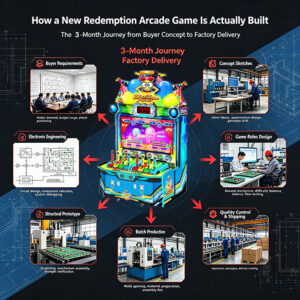
- → How a New Redemption Arcade Game Is Actually Built: The 3-Month Journey from Buyer Concept to Factory Delivery – Sunflower Amusement
- → Entre em contato conosco – Sunflower Amusement
- → Produto – Sunflower Amusement
- IAAPA | A Associação Global da Indústria de Atrações

Adicionar comentário