


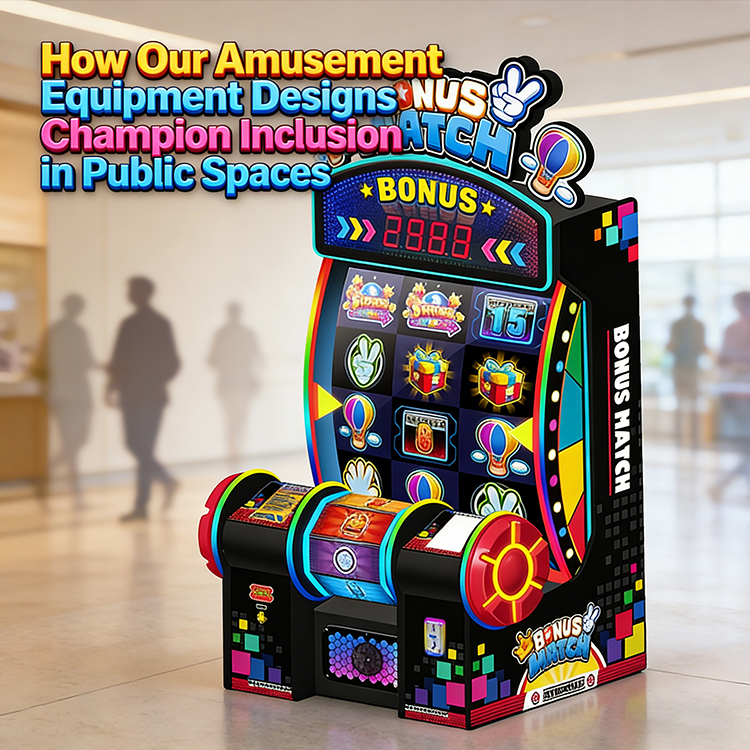
Meta Description: Discover how inclusive design principles in indoor amusement equipment and redemption game machine engineering ensure play is accessible to all ages, abilities, and backgrounds. Explore our B2B commitment.
Public spaces, from community arcades to shopping mall atriums, promise shared experiences. Yet, traditional amusement design often creates unintentional barriers. At our core, we believe play is a universal right. This drives our mission to engineer indoor amusement equipment and redemption game machine solutions that actively dismantle barriers through Universal Design—creating equitable, engaging experiences for people of all ages, physical and cognitive abilities, and backgrounds.
Pillar 1: Physical Accessibility & Adaptive Interfaces
True inclusion starts with physical access. Our B2B product development adheres to and exceeds principles of accessible design.
Adjustable Form Factors: Cabinets feature height-adjustable stands or multiple play positions (seated and standing). Clear knee space is ensured for wheelchair users.
Multi-Modal Control Schemes: We integrate a variety of control interfaces beyond standard joysticks and buttons, including touchscreens with adjustable sensitivity, trackballs, gesture-recognition cameras for limited mobility, and auditory cue systems. This is a key focus of our OEM&ODM projects for specialized venues.
Pillar 2: Cognitive & Sensory Inclusivity
Games must be understandable and enjoyable for diverse cognitive styles and sensory preferences.
Clear Visual Communication: We use high-contrast graphics, intuitive iconography, and avoid overly complex menus. Timers and instructions can be supplemented with clear auditory or tactile feedback.
Adjustable Stimulus Levels: Sound volume and lighting effects can often be moderated by the venue operator to accommodate sensory sensitivities, ensuring a comfortable environment for players with autism or sensory processing differences.
Scalable Challenge: Game logic can be designed to adapt difficulty or provide alternative win conditions, ensuring both a novice child and a skilled adult can find satisfying engagement from the same game machine.
Pillar 3: Social & Generational Bridging
Inclusive design fosters shared play across generations and social groups.
Cooperative Game Modes: We design games that encourage teamwork rather than just competition. A redemption game machine might have a “community goal” where all players contribute to a shared ticket pool, fostering a sense of collective achievement.
Intergenerational Appeal: Themes and mechanics are chosen to resonate across ages, avoiding exclusionary or overly niche content. A classic skill challenge can be visually themed in a way that delights both a grandparent and a grandchild, allowing them to play together as equals.
Our Commitment as a Manufacturing Partner
Inclusion is not a feature; it’s a foundational design philosophy. For venue owners and operators—our B2B clients—this means investing in equipment that welcomes your entire community, maximizes your addressable audience, and strengthens your venue’s reputation as a space for all. Through our OEM&ODM capabilities, we partner with forward-thinking organizations to turn specific accessibility goals into tangible, engineered reality.
By championing Universal Design, we do more than sell game machine units. We provide the tools to build more empathetic, welcoming, and vibrant public spaces. We believe that when play becomes truly accessible, it ceases to be a simple pastime and transforms into a powerful force for social connection and joy for every member of the community.



Add comment