

For distributors, arcade operators, and project buyers, one of the most important sourcing decisions is whether to work with an OEM arcade machine manufacturer or choose an ODM model.
Both options are common in the amusement industry, especially when buyers source from China, but they solve different business problems.
If your goal is to launch a custom product line, build a private-label brand, or develop machines tailored to a specific market, OEM may be the better fit. If your goal is to move faster, reduce development risk, and select from proven product structures, ODM may be the more practical choice. The right decision depends on your budget, timeline, technical involvement, and brand strategy.
This guide explains the difference between OEM and ODM arcade machine manufacturing, when each model makes sense, and what international buyers should check before placing an order.
What OEM Means in the Arcade Machine Industry
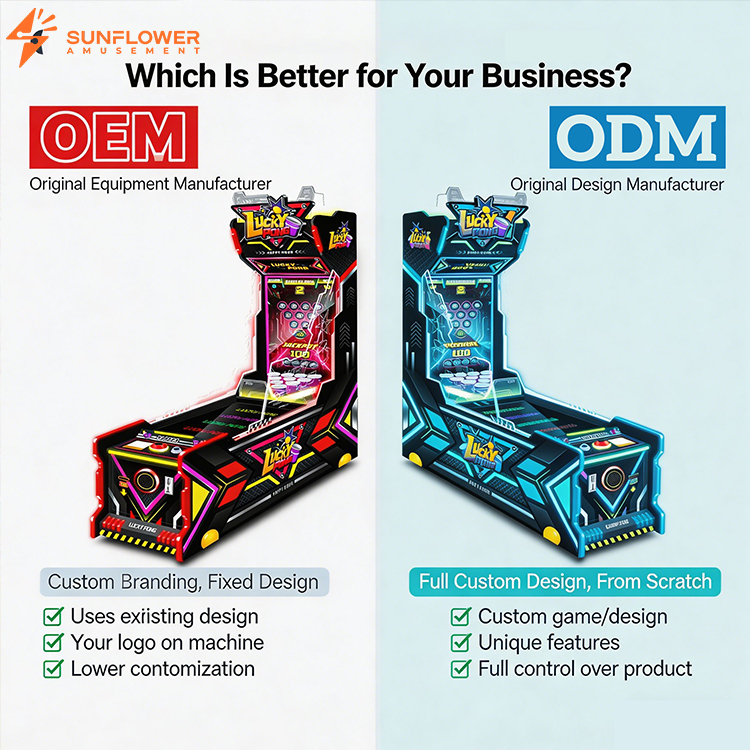
OEM stands for Original Equipment Manufacturer. In the arcade and amusement equipment sector, OEM usually means the buyer has a clearer product direction and asks the manufacturer to produce machines according to specific requirements. Those requirements may include cabinet size, artwork, software logic, screen configuration, control layout, lighting style, branding, packaging, or localized language settings.
An OEM project often starts with an existing machine platform and then adjusts it for a buyer’s market or brand. In some cases, the buyer provides drawings, references, or feature requests. In other cases, the factory helps refine the concept into a manufacturable commercial product.
For arcade businesses, OEM is valuable when differentiation matters. A distributor may want exclusive graphics, a custom cabinet shape, or machine settings designed for a regional customer profile. A chain operator may want equipment that aligns with a unified store image. A project buyer may need specific dimensions or technical standards to fit a venue plan.
What ODM Means in the Arcade Machine Industry
ODM stands for Original Design Manufacturer. In this model, the manufacturer already has a developed product design, and the buyer chooses from existing solutions that can usually be branded or adjusted within a controlled range.
For example, a supplier may already offer claw machines, prize games, simulator cabinets, or redemption machines with established structures, tested game logic, and standard production processes. The buyer can then choose from those models and request smaller modifications such as logo placement, color changes, language options, voltage selection, or cabinet branding.
ODM is often the faster route because the product framework already exists. This reduces development time, lowers engineering uncertainty, and helps buyers start with machines that are already closer to production readiness.
OEM vs ODM: The Key Differences Buyers Should Understand
Although OEM and ODM are related, they differ in several practical areas.
Product Development Involvement
OEM usually requires more buyer input. The manufacturer produces based on specific requests, so the buyer often needs to clarify product goals, desired functions, and branding details.
ODM requires less development work from the buyer. The main structure already exists, so the decision is more about selecting the right model and confirming acceptable modifications.
Customization Level
OEM generally offers deeper customization. It is the better route when the buyer wants a more unique product presentation or a closer match to brand standards.
ODM offers moderate customization, but within the boundaries of an existing product platform. This is often enough for buyers who need speed and commercial practicality.
Lead Time
OEM projects usually take longer because product details, samples, testing, and revisions may all be part of the process.
ODM projects are usually faster because the factory is working from an established base product.
Development Risk
OEM can bring stronger differentiation, but it also carries more decision complexity. If the product concept is unclear, development may slow down or become more expensive.
ODM usually lowers risk because the factory is not starting from zero. Buyers can evaluate a more mature product structure before making a commitment.
Budget Fit
OEM may require more budget for development, sampling, and custom materials.
ODM is often more cost-efficient for buyers who want to launch quickly without investing heavily in full product development.
When OEM Is the Better Choice
OEM is often the right model when your business needs stronger product control or brand separation.
- You want custom branding beyond a simple logo update.
- You need cabinet dimensions or features tailored to a project.
- You want a machine concept built around your market preferences.
- You need a more exclusive offer for distribution.
- You are building a long-term private-label arcade equipment line.
For example, if you supply entertainment centers in a specific country and want machines designed around local player behavior, language, and venue size, OEM can provide a stronger competitive advantage.
When ODM Is the Better Choice
ODM is often the better option when speed, practicality, and production stability matter most.
- You want to choose from proven commercial models.
- You need shorter lead times.
- You want lower development complexity.
- You prefer tested machine structures over custom engineering.
- You want to start with a smaller buying risk.
This model works well for importers, wholesalers, and new distributors that want a reliable starting product range without building each machine from scratch.
Questions to Ask Before Choosing OEM or ODM
Before starting a project, buyers should ask the manufacturer several practical questions.
- What parts of the machine can be customized?
- What is the expected sampling and production timeline?
- What information does the factory need before quotation?
- Are artwork, voltage, software language, or cabinet details adjustable?
- What is the MOQ for OEM and ODM orders?
- How are spare parts, after-sales support, and documentation handled?
- Has the factory completed similar export projects before?
These questions help buyers compare not just price, but also execution capability.
How to Evaluate an Arcade Machine Manufacturer in China
Whether you choose OEM or ODM, supplier quality matters as much as the manufacturing model. A reliable arcade machine manufacturer should be able to provide clear specifications, product photos or videos, export experience, communication efficiency, and practical after-sales support.
Buyers should also look for evidence of manufacturing capability, including product categories, workshop scale, testing process, packaging standards, and responsiveness. In cross-border sourcing, smooth communication and realistic delivery expectations are essential.
A strong supplier does not only say that customization is possible. They explain what can be changed, what cannot be changed efficiently, and how to move from inquiry to production with fewer delays.
Why This Decision Matters for Long-Term Business Growth
Choosing between OEM and ODM affects more than a single order. It influences brand positioning, cost structure, product differentiation, and how quickly you can expand your catalog.
If your business strategy depends on exclusive offerings and long-term brand building, OEM may create more value over time. If your strategy depends on faster market entry, stable supply, and lower development pressure, ODM may be the smarter commercial route.
There is no universal answer for every buyer. The best model is the one that matches your sales channel, customer expectations, and operational capacity.
Reflexiones finales
OEM and ODM arcade machine manufacturing each offer clear business advantages. OEM is better for deeper customization, stronger branding, and more product control. ODM is better for speed, lower complexity, and access to established product solutions.
For buyers sourcing amusement equipment from China, the best next step is to compare your project goals with the supplier’s real manufacturing capability. When the manufacturing model matches your business plan, you can reduce sourcing risk and make better long-term purchasing decisions.
Preguntas frecuentes
OEM arcade machines are produced based on buyer requirements and usually involve deeper customization. ODM arcade machines are based on designs the manufacturer already developed, with limited but useful customization options.
Not always. OEM is better for buyers who want stronger customization and brand differentiation. ODM is better for buyers who want faster production and lower development complexity.
In many cases, yes. Many ODM suppliers allow branding changes such as logos, color adjustments, language settings, and selected cabinet details.
China has a mature amusement equipment supply chain, a wide product range, strong export experience, and flexible OEM and ODM manufacturing options for different buyer needs.
Ask about customization scope, MOQ, sample lead time, technical requirements, after-sales support, and whether the supplier has handled similar projects before.
Sugerencias de enlaces internos
CTA: Get a Quote for your OEM or ODM arcade machine project, or contact Sunflower Amusement to discuss the right manufacturing model for your market.



Añadir comentario